
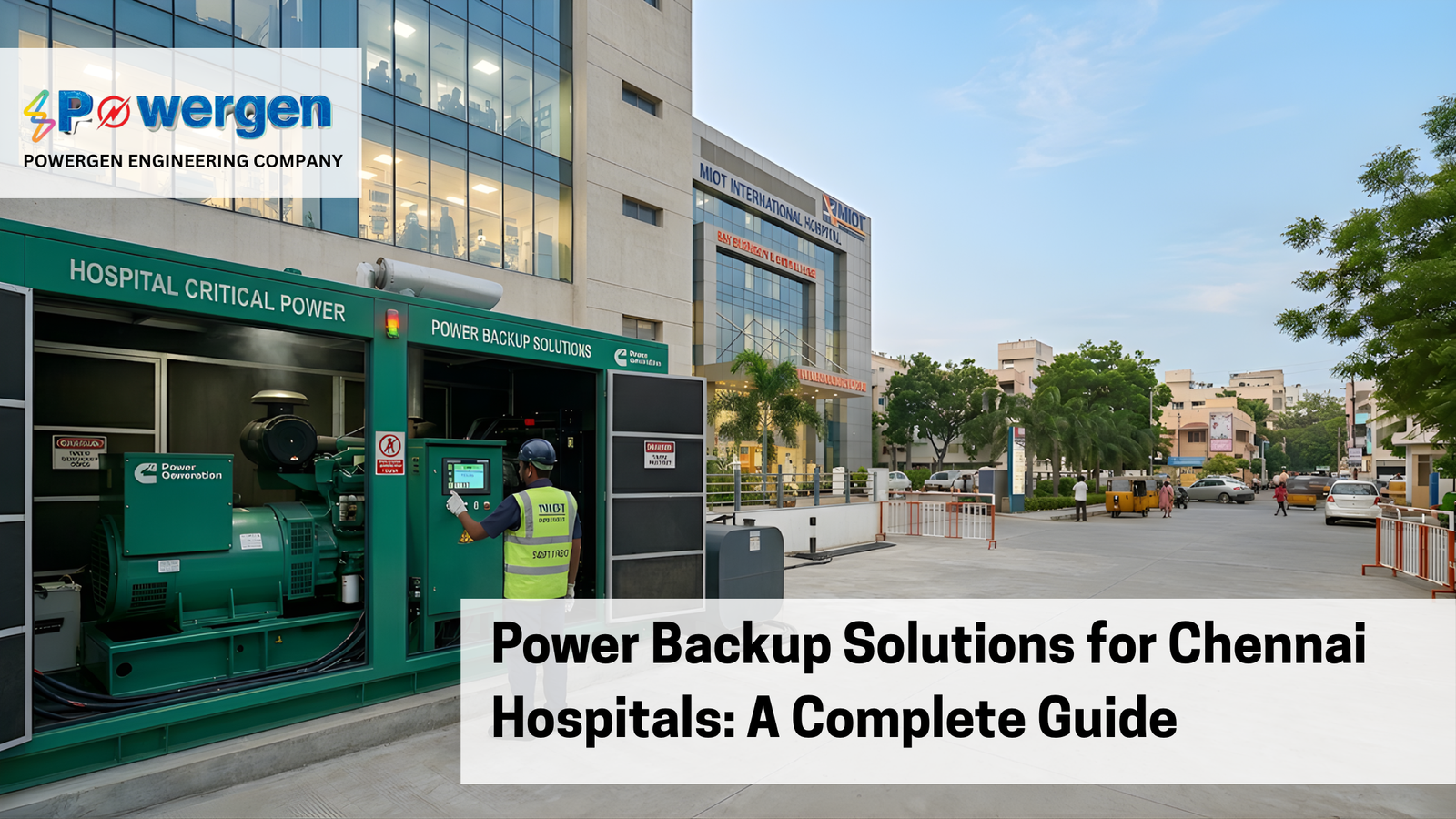
Power Backup Solutions for Chennai Hospitals: A Complete Guide
Table of Contents
Introduction: Why Hospital Power Backup in Chennai Is a Life-Safety Issue
In a Chennai hospital, a power outage is never just an inconvenience. It is a medical emergency. A ventilator that stops. A surgery interrupted by darkness. A blood bank that warms by one degree too many. For the estimated 400+ hospitals, 2,000+ clinics, and hundreds of diagnostic centres operating across Chennai and its suburbs, robust power backup solutions for Chennai hospitals are not an infrastructure option; they are a patient safety obligation and a legal requirement.
Chennai’s power infrastructure, while significantly improved in recent years, still experiences outages driven by grid overload in peak summer, transformer failures, and most critically, the northeast monsoon, which disrupts supply across large parts of the city every October to December. The 2015 Chennai floods cut power to many medical facilities for 48 to 72 hours. Any hospital whose power backup system was not designed for extended outages faced catastrophic consequences.
This complete guide from Powergen Engineering Company, a Chennai-based specialist in hospital power backup solutions, covers everything your facility needs to know: from load classification and technology selection to generator sizing, NABH compliance, CPCB IV+ requirements, and the most common mistakes that Chennai hospitals make with their power backup systems.
Power backup solutions are critical for hospitals in Chennai, where uninterrupted power is required for ICUs, OTs, and emergency care. This guide explains diesel generators for hospitals in Chennai, silent generators for hospitals in Chennai, and NABH-compliant backup systems.
Critical Power Loads in a Chennai Hospital
Effective hospital power backup planning in Chennai begins with classifying your loads into tiers based on how long they can tolerate a power interruption. The National Accreditation Board for Hospitals (NABH) and the Central Electricity Authority (CEA) both provide frameworks for essential supply classification in healthcare facilities. The table below adapts these frameworks to a practical Chennai hospital context:
| Load Tier | Equipment Examples | Power Backup Requirement |
|---|---|---|
| ESSENTIAL (0-second tolerance) | OT Lights & Equipment, ICU Ventilators, Cardiac Monitors, Life-Support Machines, Anaesthesia Systems, Neonatal Care Units | Must be on a dedicated UPS with zero transfer time. Any power gap here is a patient safety emergency. |
| IMPORTANT (10–15 second tolerance) | Operation Theatre Air Handling, Blood Bank Refrigerators, CT/MRI Scanners, X-Ray Units, Dialysis Machines, Pharmacy Cold Storage | Should be on UPS with a generator as a second layer. Generator ATS must restore within 10 seconds. |
| STANDARD (30–60 second tolerance) | General Ward Lighting, Nurses' Stations, Lifts & Elevators, CCTV & Security, Administrative Computers, Cafeteria Equipment | Connected to the generator via ATS. Normal generator changeover time of 10–30 seconds is acceptable. |
| NON-CRITICAL (Can defer to grid restore) | Non-essential air conditioning, External signage, Staff recreation areas, Parking systems | Load shedding acceptable during generator operation to preserve capacity for critical systems. |
Essential Loads Cannot Lose Power for Even 1 Second
Operating theatre equipment, ICU ventilators, cardiac monitors, anaesthesia machines, and neonatal care units are life-support devices. A single-second interruption can cause patient harm or death. These loads must be connected to an online UPS system with zero transfer time. The generator backs up the UPS, not the equipment directly. This is the most critical element of any power backup solution for a Chennai hospital. These power backup solutions ensure zero interruption in critical hospital operations
Important Loads Must Restore Within 10-15 Seconds
CT and MRI scanners, blood bank refrigerators, dialysis machines, and pharmacy cold storage can tolerate a brief interruption but must be on generator power within 10 to 15 seconds. An Automatic Mains Failure (AMF) panel with a fast-start generator is essential for this tier. Cold storage temperatures that rise even briefly can render blood products and vaccines unsafe.
Non-Critical Loads Can Tolerate Brief Interruption
General ward lighting, administrative computers, CCTV systems, and non-essential air conditioning can be restored within 30 to 60 seconds via a standard ATS. Non-essential HVAC should be configured for load shedding during generator operation to preserve generator capacity for critical systems. This load management discipline is frequently overlooked in Chennai hospital power backup configurations and is a common cause of generator overload during extended outages.
Power Backup Solutions Technologies for Chennai Hospitals
A complete hospital power backup solution in Chennai uses multiple technologies in layers, each with a specific role. The table below summarises the key technologies:
| Technology | Runtime | Transfer Time | Cost Level | Hospital Role |
|---|---|---|---|---|
| Diesel DG Set | Unlimited (fuel) | 10–30 sec ATS | Medium–High | Core backbone of hospital power backup supplying all loads once running |
| Online UPS | 10–30 min (battery) | 0 milliseconds | High | Zero transfer time for ICU, OT, and life support. DG recharges UPS |
| Offline / Line-Interactive UPS | 10–30 min (battery) | 4–20 ms | Medium | Suitable for computers and non-critical loads only, not life-safety systems |
| N+1 Parallel DG Sets | Unlimited (fuel) | 10–30 sec ATS | Very High | Backup redundancy. If one DG fails, another takes over instantly |
| ATS / AMF Panel | N/A (control only) | Auto switchover | Essential | Detects power failure, starts generator, and transfers load automatically |
Diesel Generator for Hospitals Chennai (DG Sets)
The diesel generator set is the backbone of every hospital’s power backup system in Chennai. Once the ATS or AMF panel detects a mains failure and starts the generator, it supplies power to all loads within 10 to 30 seconds. For hospitals, silent diesel generators in Chennai are essential acoustic canopies that reduce operational noise to 65–72 dB, complying with both TNPCB urban noise limits and the patient care environment. Powergen supplies CPCB IV+ certified silent generators from 30 KVA to 3000 KVA, fully configured for healthcare applications. Explore hospital-grade diesel generators for commercial use. Choosing the right diesel generator for hospitals Chennai is essential for reliable backup performance.
UPS Systems Online and Offline
For life-critical equipment, the generator alone is insufficient. An online UPS, also called a double-conversion UPS, provides truly zero transfer time by continuously powering the connected load from its battery while keeping the battery charged from the mains or generator. When mains fail, the load does not experience any power interruption whatsoever; the battery simply continues supplying. This is the only acceptable power backup solution for ICU and OT equipment in Chennai hospitals. Offline and line-interactive UPS systems with 4-20ms transfer times are not suitable for life-support equipment.
N+1 Generator Redundancy with Synchronizing Panels
For hospitals with 100+ beds or any facility with OT and ICU suites, N+1 generator redundancy is the gold standard. N+1 means you have one more generator than the minimum required, so if any single unit fails or requires maintenance, the remaining generators automatically assume the full load via a synchronizing panel. Powergen’s generator synchronizing panels enable two or more generators to operate in parallel, sharing the load proportionally and providing seamless, automatic failover. This is the most robust power backup configuration available for Chennai hospitals.
Automatic Transfer Switch (ATS) and AMF Panels
An Automatic Transfer Switch (ATS) detects mains failure and switches the load to the generator without manual intervention. An Automatic Mains Failure (AMF) panel combines ATS with a generator auto-start. It monitors the mains supply, and when the voltage drops below the set threshold, it automatically starts the generator and transfers the load. For Chennai hospitals, AMF panels with generator start-to-load times under 10 seconds are recommended for important-load circuits. The Central Electricity Authority (CEA) specifies minimum standards for ATS and AMF installations in essential service buildings.
Silent Generator for Hospitals Chennai Benefits
A silent generator for Chennai hospitals is not a preference; it is a clinical and regulatory requirement. Operating theatre environments, ICU wards, neonatal care units, and patient recovery rooms require controlled acoustic environments. The NABH accreditation standards for hospitals include provisions for noise management in clinical areas. A generator producing 85–100 dB, the output of an open frame unit cannot be operated near a clinical area without extensive acoustic isolation.
Powergen’s silent generating sets produce 65–72 dB at one metre from the canopy. This level is suitable for generator rooms adjacent to clinical buildings and can be further reduced to 55–60 dB with a generator alcove and minimal acoustic treatment. Additionally, TNPCB‘s noise limits of 55 dB(A) daytime in residential zones and 65 dB(A) in commercial zones apply to hospital sites across Chennai. A silent generator is the only type that can approach these limits without a fully enclosed bunker-style generator room.
For multi-storey hospital buildings in dense Chennai neighbourhoods, such as Anna Nagar, Nungambakkam, Velachery, Tambaram, or OMR, where the generator may be installed on a terrace, basement, or side yard adjacent to patient wards, silent generators are the definitive power backup choice for Chennai hospitals. View Powergen’s silent generator product range. Silent generator for hospitals Chennai is necessary to meet TNPCB noise regulations.
CPCB IV+ and TNPCB Compliance for Hospital Generators
Every new diesel generator purchased for a Chennai hospital must meet CPCB IV+ emission standards as mandated by the Central Pollution Control Board under the Environment (Protection) Act, 1986. Non-CPCB IV+ generators are illegal for new installations and can trigger enforcement action from the Tamil Nadu Pollution Control Board (TNPCB), including Consent-to-Operate (CTO) notices that can impact your hospital’s operating licence.
For hospital licensing and accreditation in Tamil Nadu, CPCB IV+ compliance also intersects with NABH accreditation requirements and health department facility inspections. Hospitals seeking or renewing NABH accreditation must demonstrate compliant backup power systems. Non-compliant generators are an accreditation liability.
Key compliance requirements for hospital power backup solutions in Chennai:
- All new DG sets must carry a valid CPCB IV+ type-approval certificate
- Generators must run on BS VI diesel, and confirm fuel supply chain compliance
- Noise levels must be at or below 75 dB(A) at 1 metre from the enclosure
- TNPCB consent conditions must be verified for your specific facility zone
- Exhaust routing must meet CEA and local building bylaws for hospital buildings
- Fuel tank capacity must comply with NABH guidelines; a minimum of 24 hours at full load is recommended
Generator Sizing for Power Backup Solutions in Chennai Hospitals
Correct generator sizing is the single most important engineering decision in hospital power backup planning in Chennai. Both undersizing and oversizing create serious risks. Undersizing causes overload and shutdown during an outage, while severe oversizing leads to wet stacking, reduced engine life, and wasted capital.
Follow these five steps to size your hospital generator correctly:
- Step 1: List all loads by tier: Create a complete inventory of essential, important, standard, and non-critical loads with their kW ratings and which will run simultaneously on generator power
- Step 2: Calculate total running kW. Add the running kW of all loads operating simultaneously on generator power, excluding those that will be load-shedded.
- Step 3: Apply motor starting factors: Multiply any motor load (HVAC compressors, pumps, lifts) by its starting factor, typically 3 to 7 times the running kW, to determine starting KVA demand
- Step 4: Convert to KVA: Divide total running kW by 0.8 (standard power factor) to get the minimum required KVA rating
- Step 5: Add 25–30% headroom: For hospitals, always size the generator at 70–75% of its rated capacity at full operational load. This headroom accommodates future equipment additions and prevents overload
| Hospital Type | Recommended KVA | Recommended Config. | Key Design Principle |
|---|---|---|---|
| Small Clinic / Nursing Home (<30 beds) | 30–62.5 KVA | 1 × Silent DG + UPS for OT/ICU | Cover essential loads + basic HVAC |
| Mid-Size Hospital (30–100 beds) | 100–200 KVA | 1 × Silent DG + Online UPS | Full facility backup with load priority panel |
| Large Hospital (100–250 beds) | 250–500 KVA | N+1: 2 × DG + Sync Panel + UPS | Redundancy for OT, ICU, MRI, Blood Bank |
| Multi-Speciality Hospital (250–500 beds) | 500–1000 KVA | N+1 / N+2 Parallel DGs + UPS | Zone-wise critical load distribution |
| Super-Speciality / Medical Campus (500+ beds) | 1000–3000 KVA | Multiple Parallel DGs + HV Option | Dedicated power zones per department |
Powergen Engineering Company provides free generator sizing consultations for Chennai hospitals. Our engineers conduct an on-site load assessment, review your electrical single-line diagram, and recommend the right KVA and configuration for your facility. Contact us here to schedule a free site visit.
Complete Hospital Power Backup Configuration Table
This table provides Powergen’s recommended power backup configuration for each area of a Chennai hospital, based on clinical requirements, NABH standards, and Chennai’s specific grid and climate conditions:
| Hospital Area / Load | UPS | Transfer Time | Primary Backup | Redundancy | Design Note |
|---|---|---|---|---|---|
| OT / ICU / Life-Support | Online UPS | 0 ms | DG Set | N+1 DG | Zero interruption mandatory. UPS bridges the gap; DG takes over within 10 sec. |
| Blood Bank & Cold Storage | UPS | 0 ms | DG Set | AMF Panel | Temperature continuity is critical for patient safety. |
| CT / MRI Scanners | UPS | <10 ms | DG Set | ATS | Prevents data loss and equipment damage during power cuts. |
| Dialysis Units | UPS | 0 ms | DG Set | AMF Panel | Power loss mid-treatment is life-threatening. |
| OT Air Handling Units (AHU) | None | Generator | DG Set | AMF Panel | ATS + DG restore within 10–15 sec is acceptable. |
| General Ward Lighting | None | Generator | DG Set | ATS | 30-sec ATS acceptable. Emergency lights bridge gap. |
| Lifts & Elevators | None | Generator | DG Set | ATS | Priority restore to avoid stranded patients. |
| CCTV & Access Control | Small UPS | <10 ms | DG Set | ATS | Ensures security continuity during outages. |
| Admin / IT Systems | UPS | <10 ms | DG Set | ATS | Protects patient data and EHR systems. |
| Non-Essential HVAC | None | Load Shed | Optional | Manual | Load shedding preserves generator capacity for critical loads. |
Common Power Backup Mistakes in Chennai Hospitals
These are the seven most dangerous mistakes Chennai hospitals make with their power backup systems. Every one of them has caused real patient safety incidents in Indian healthcare facilities:
| Mistake | Why It Puts Patients at Risk |
|---|---|
| Single Generator, No Redundancy | A single generator creates a failure point. If it breaks during outage, the entire hospital loses power. Always design N+1 redundancy. |
| No UPS on Critical Circuits | ATS takes 10–30 seconds. ICU ventilators and life-support systems cannot tolerate even a few seconds of downtime. Online UPS is mandatory. |
| Undersizing the Generator | Future expansion overloads the system. Always design with 25–30% headroom to prevent failure. |
| No Load Priority / Shedding Plan | Running at 100% load risks shutdown. Load shedding protects critical systems during outages. |
| Incorrect Fuel Tank Sizing | Hospitals require minimum 24-hour fuel backup. Smaller tanks fail during long outages or monsoon disruptions. |
| Non-CPCB IV+ Generator Purchase | Non-compliant units risk TNPCB penalties, NABH issues, and operational shutdown. |
| No Annual Load Bank Testing | Low-load testing causes wet stacking. Generator may fail under real emergency conditions. |
Conclusion: Build a Power Backup System Your Patients Can Depend On
For Chennai hospitals, power backup solutions are not a budget line; they are the difference between a safe facility and a dangerous one. A well-engineered hospital power backup system in Chennai layers online UPS for zero-transfer-time critical load protection, CPCB IV+ certified silent diesel generators for facility-wide backup, AMF panels for automatic load restoration, and N+1 redundancy for uninterruptible operation even during generator maintenance or failure.
Chennai’s northeast monsoon, tropical heat, dense urban environment, and strict TNPCB noise regulations make the silent generator the definitive choice for hospital power backup across the city. Combined with correct fuel storage sizing, annual load bank testing, and a documented load priority plan, this system ensures your hospital can operate safely through any grid event Chennai’s climate can produce.
Powergen Engineering Company has the engineering expertise, product range, and Chennai-specific knowledge to design and supply the right power backup solution for your hospital, from a 50 KVA silent genset for a nursing home in Tambaram to a multi-megawatt N+1 parallel system for a super-speciality campus in OMR. Every solution comes with CPCB IV+ certification, full installation documentation, and ongoing after-sales support.
Chennai Hospital Power Backup Challenges
Power backup solutions in Chennai hospitals must handle monsoon outages, humidity, and long power cuts. Proper system design ensures uninterrupted patient care.
FAQs:
Q1. What is the minimum power backup requirement for a hospital in Chennai under NABH standards?
NABH (National Accreditation Board for Hospitals) standards require that hospitals maintain an uninterrupted power backup system for all essential clinical areas, specifically OTs, ICUs, neonatal units, and emergency departments. The standards mandate zero-interruption power for life-support equipment (via online UPS), generator backup for the entire facility within 10 seconds (via AMF panel), and adequate fuel storage for a minimum of 24 hours at full load. For hospitals in Chennai, these NABH requirements align with and are reinforced by TNPCB Consent-to-Operate conditions and the CEA‘s electrical installation standards for essential service buildings. Powergen’s hospital power systems are engineered to meet all three frameworks simultaneously.
Q2. Why is N+1 generator redundancy important for Chennai hospitals, and how does it work?
N+1 redundancy means your hospital has one more generator than the minimum needed to supply the full load. For example, if your hospital needs 500 KVA of backup power, an N+1 system would use two 500 KVA generators, each capable of handling the full load independently. A synchronizing panel connects both generators in parallel, sharing the load between them during normal operation. If one generator fails or requires maintenance, the synchronizing panel automatically transfers the full load to the remaining unit within milliseconds with no interruption to patient care.
For Chennai hospitals, N+1 redundancy is essential for any facility with an operating theatre or ICU suite. The northeast monsoon regularly causes multi-hour outages, and a single generator that fails during this period without redundancy is a patient safety emergency. Powergen supplies and commissions N+1 hospital power backup systems across Chennai with synchronizing panels, automatic load transfer, and full AMF control.
Q3. How long should a Chennai hospital’s generator fuel tank last, and how much storage is recommended?
NABH guidelines recommend a minimum 24-hour fuel supply at full generator load for hospitals. However, given Chennai’s northeast monsoon history, particularly events like the 2015 floods, where power outages lasted 48 to 72 hours across large parts of the city, Powergen strongly recommends a minimum 48-hour fuel capacity for any Chennai hospital with OT and ICU facilities. For a 250 KVA generator running at 70% load, this means approximately 800 to 1,000 litres of on-site diesel storage. Your hospital power backup plan should also include a fuel replenishment protocol, a pre-agreed arrangement with a diesel supplier for emergency top-up during extended grid outages.
Q4. Why should Chennai hospitals choose Powergen Engineering Company for their power backup systems?
Powergen Engineering Company brings three critical advantages to hospital power backup solutions in Chennai: specialist engineering expertise in healthcare power systems, a complete product range from UPS-grade silent generators to N+1 synchronizing systems, and deep familiarity with Chennai’s specific regulatory, climate, and infrastructure context. We supply CPCB IV+ certified silent generators from 30 KVA to 3000 KVA, synchronizing panels for N+1 configurations, and AMF control systems, all supported by free site assessments, load analysis, and after-sales service across Chennai, Chengalpattu, Kancheepuram, and Tiruvallur. Call +91 9840737919 or visit www.powergenco.in to speak with a hospital power specialist today.
Q5. What does Powergen supply and its scope?
Powergen supplies complete hospital power backup systems including generators, synchronizing panels, and AMF controls with site assessment and installation. Ongoing maintenance and AMC are not included and must be handled separately.