
Diesel Generator for Apartment Chennai Complex: Complete Buying Guide 2026
Table of Contents
Introduction: Power Cuts Are Not Going Away in Chennai
Ask any Resident Welfare Association secretary in Chennai, and they will tell you the same thing. Power cuts are the number one complaint from residents. Not parking disputes. Not maintenance fees. Power cuts.
Chennai’s grid has improved significantly over the past decade, but it has not eliminated the problem, and it never will completely. Scheduled load shedding still affects residential areas during peak-demand months. The northeast monsoon knocks out feeders every single year. And rapid urban development across the OMR, Perumbakkam, Mogappair, Ambattur, and Porur corridors means that new apartments are being commissioned faster than substation infrastructure can keep up.
The result? Your RWA needs a diesel generator for apartment Chennai installations. Not as a luxury. As a basic obligation to your residents. Getting this decision right, the correct KVA generator for apartment complexes in Chennai, the right type, and a CPCB IV+ certified unit will keep residents happy and your RWA out of trouble for the next 20 years. Getting it wrong will cost you in complaints, committee meetings, and expensive replacements.
This guide from Powergen Engineering Company, a specialist diesel generator supplier in Chennai, gives you exactly what your RWA needs to make a smart, confident purchase in 2026.
What Loads Does an Apartment Complex Actually Need to Back Up?
Before you talk to a single generator dealer in Chennai, you need to answer one question: what exactly are you backing up? This sounds obvious. It is not. The majority of Chennai RWAs who get their generator sizing wrong do so because they did not build a proper load list before buying.
The truth is, not every load in your apartment complex needs to be on the generator. Your residents’ individual flat loads, ACs, televisions, and kitchen appliances are rarely covered by the common area generator. What the generator is responsible for is the building’s common area and critical infrastructure. When evaluating backup power for apartments in Chennai, here is what that typically includes:
| Load Type | Typical Draw | Applies To | What Your RWA Needs to Know |
|---|---|---|---|
| Common Area Lighting | 2–8 kW | All complexes | Low draw but must never fail. Residents expect lights in corridors and lobbies at all times |
| Lifts / Elevators (per lift) | 7–15 kW | G+3 and above | Starting current is 3–5x running current. This is where most RWAs undersize their generator |
| Water Pumps (sump + overhead) | 5–15 kW | All complexes | Two pumps running simultaneously is common. Size for both, not one |
| Fire Pump | 5–22 kW | TNPCB / NBC mandated | Non-negotiable load. Must be on the generator regardless of the complex size |
| CCTV and Security Systems | 1–3 kW | All complexes | Low draw but critical. Include in your load list |
| Club House / Gym (partial) | 10–40 kW | Premium complexes | Confirm with your RWA whether a partial clubhouse backup is required |
| Corridor / Stairwell AC | 5–20 kW | Select complexes | Often overlooked during load calculation. Ask your dealer explicitly |
The generator for lift and pump Chennai requirements alone account for the majority of the starting current demand in most complexes. Build your load list from this table before you approach any apartment generator dealer in Chennai. Walk the property with your electrical contractor. Count lifts, pumps, and lighting circuits. Do not guess. A load list that takes two hours to prepare can save your RWA from buying the wrong generator, and that mistake costs far more than two hours of anyone’s time.
How to Calculate the Right KVA for Your Chennai Apartment Complex
Here is where most RWAs go wrong. They take their total connected load in kilowatts, divide by 0.8 for power factor, and arrive at a KVA figure. Then they buy that exact size. And then they wonder why their generator trips two months later when the fire pump kicks in.
The problem is starting current. Electric motors, and every lift, pump, and fire pump in your complex, run on an electric motor, draw three to six times their rated running current at startup. That surge lasts only a few seconds, but it is enough to trip a generator sized purely on running loads. The generator for lift and pump Chennai applications must handle the worst-case simultaneous starting scenario: two lifts starting at the same time, both pumps running, and the fire pump on standby. If your KVA generator for the apartment in Chennai cannot absorb that peak without dropping voltage or tripping, residents will notice immediately.
The right approach is to calculate your total running load first, add a 25 to 30% buffer for motor starting currents, add another 10 to 15% for Chennai’s ambient temperature derating, and round up to the next standard KVA size. Never round down. Use the table below as a starting reference, but always have a qualified engineer verify the final number for your specific complex:
| Complex Size | Key Loads | Recommended KVA Range | Powergen's Honest View |
|---|---|---|---|
| Small complex (20–40 flats, G+3 to G+5) | 1–2 lifts, 2–3 pumps | 62.5 – 82.5 KVA | Most RWAs in this bracket buy 62.5 KVA and regret it when the fire pump runs along with both lifts starting |
| Mid-size complex (40–100 flats, G+5 to G+10) | 2–4 lifts, 3–4 pumps | 100 – 160 KVA | 125 KVA is the sweet spot for most mid-size Chennai complexes. Do not size below this for G+7 and above |
| Large complex (100–250 flats, G+10 to G+20) | 4–8 lifts, 4–6 pumps | 200 – 320 KVA | 250 KVA is common, but if your complex includes clubhouse backup, size up to 320 KVA |
| Premium / Large township (250+ flats, G+20+) | 8+ lifts, 6+ pumps | 400 KVA and above | Use multiple generators with a synchronising panel. A single large genset creates a single point of failure |
One more thing worth stating plainly: if your complex is planning to expand, size your KVA generator for apartment Chennai requirements for where the complex will be in five years, not where it is today. Replacing a generator because you outgrew it is an expensive and entirely avoidable problem.
Silent Generator vs Open Frame: There Is Only One Right Answer for Apartments
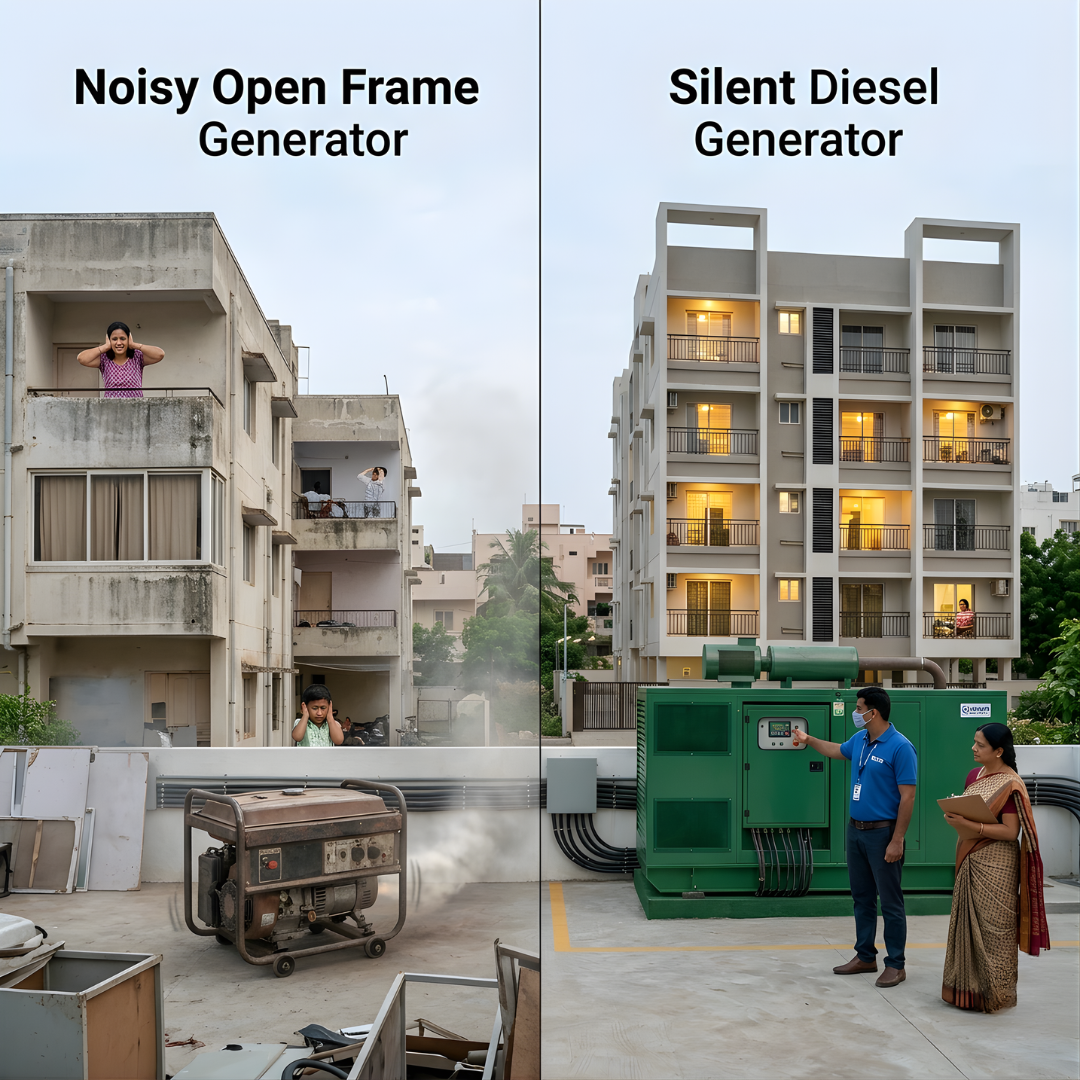
This is not really a debate for Chennai apartments. The answer is a silent generator for apartments Chennai. Full stop.
Open frame generators produce between 85 and 100 dB of noise at one metre. The Tamil Nadu Pollution Control Board (TNPCB) sets a noise limit of 55 dB(A) daytime and 45 dB(A) night-time in residential zones. An open frame generator in a residential compound does not just breach that limit; it obliterates it. You will receive a TNPCB notice. Your residents will complain from day one. And your RWA will eventually have to replace the unit anyway, having wasted the original purchase price.
A silent generator for apartments Chennai, fitted with a factory-engineered acoustic canopy, operates at 65 to 75 dB at one metre. Installed in a well-ventilated generator alcove or on an outdoor pad, the noise level drops further with distance. Residents two floors above a basement generator room will barely register it is running. That is the outcome your RWA needs.
Do not let a dealer talk you into an open-frame unit because it is cheaper. The price difference between a silent and open frame generator of the same KVA is typically Rs. 50,000 to Rs. 1.5 lakh. The cost of a TNPCB enforcement notice, an RWA meeting in crisis mode, and a forced replacement is significantly higher. Buy silence. Buy it once. Explore Powergen’s range of diesel generators for commercial and residential use to find the right silent configuration for your complex.
CPCB IV+ Compliance: Non-Negotiable in 2026
Every new diesel generator for apartment Chennai complexes purchased in 2026 must comply with the Central Pollution Control Board’s CPCB IV+ emission standard. This is not optional. It is the law under the Environment (Protection) Act, 1986.
What does that mean for your RWA in practice? It means you should ask every dealer you approach for the CPCB type-approval certificate before discussing price. Genuine CPCB IV+ compliant generators cost 15 to 25% more than non-compliant units because the engine technology required is more expensive to build. If a dealer is quoting you a price that seems unusually low, the most likely explanation is that the unit is non-compliant, refurbished, or grey-market stock.
Operating a non-CPCB IV+ generator providing backup power for apartments Chennai exposes your RWA to TNPCB enforcement notices, financial penalties of up to Rs. 1 lakh per day under the EP Act, and potential cancellation of your building’s occupancy certificate in extreme cases. No RWA secretary wants to be explaining that at an AGM. Buy compliant from day one, and the problem never arises.
Chennai-Specific Factors Every RWA Must Consider
Chennai is not just any Indian city. It has specific climate and infrastructure characteristics that directly affect how your apartment complex generator should be specified, installed, and operated. Here is what your RWA needs to factor in.
The Heat Derating Problem
Generator manufacturers rate their equipment at 25°C ambient temperature. Chennai summers regularly push 36 to 38°C, sometimes higher in May and June. At those temperatures, a generator derated at 1% per degree above 25°C is effectively producing 11 to 13% less power than its nameplate says. A 125 KVA generator in peak Chennai summer is, realistically, closer to 110 KVA of usable output. Your sizing calculation must account for this. Build in at least 15% thermal headroom on top of your calculated load, not instead of it.
The Northeast Monsoon Risk
From October to December, Chennai gets hit hard. The northeast monsoon brings extended heavy rainfall that floods low-lying areas, knocks out TNEB feeders for hours at a stretch, and creates exactly the conditions where your backup power for apartments Chennai matters most. Make sure your generator installation is weatherproofed. If the unit is installed outdoors, it needs a silent canopy, which it should have anyway. If it is in a basement or ground-level alcove, verify that the space is flood-protected and that exhaust and ventilation openings cannot be submerged. A generator room that floods during a monsoon event is worse than having no generator at all.
Salt Air Corrosion: Coastal Chennai, Especially
Apartments along the East Coast Road, Besant Nagar, Thiruvanmiyur, Neelankarai, and anywhere within three to five kilometres of the coast face an additional challenge: salt-laden air accelerates corrosion of exposed metal components, wiring terminals, and alternator windings. If your complex is in a coastal Chennai neighbourhood, specify a silent generator for apartments Chennai with a corrosion-resistant acoustic enclosure, stainless steel hardware where possible, and ask your supplier explicitly about salt air protection. Powergen’s engineers factor this into product recommendations for coastal Chennai apartment complexes as standard practice.
Space and Ventilation Constraints
Chennai apartments, particularly in older localities like Adyar, Mylapore, and Anna Nagar, often have limited space for generator installations. The generator alcove may be small, badly ventilated, or positioned in a corner that restricts exhaust routing. Poor ventilation is one of the most common causes of premature generator failure in Chennai residential complexes. Hot exhaust gases recycling back into the generator’s intake air cause the engine to run hotter than designed, accelerating wear and reducing output. Ensure the generator room has adequate fresh air inlet area and that exhaust is routed well clear of any return air path.
Common Mistakes Chennai Apartment Buyers Make
These are the mistakes Powergen’s engineers see repeatedly across Chennai apartment generator purchases. Your RWA does not need to repeat them.
Buying on Price Alone
The cheapest quote almost always means the wrong generator. It might be non-CPCB IV+ compliant. It might be a refurbished unit sold as new. It might be correctly priced for the wrong KVA. Price is one input into the decision, not the decision itself. The cost of replacing an undersized or non-compliant diesel generator for apartment Chennai use in year three is multiples of the money saved on the original purchase.
Ignoring the Fire Pump Load
This happens constantly. An RWA calculates lifts, pumps, and lighting, arrives at a comfortable KVA figure, buys the generator, and then discovers that the fire pump was never included in the load list. Fire pumps are mandatory in buildings above a certain height under Tamil Nadu’s National Building Code provisions, and they are non-negotiable loads. The generator for lift and pump Chennai calculations must include the fire pump. A fire pump drawing 15 kW that was not in the original load calculation can push a generator past its rated capacity the moment a fire alarm triggers. Include it. Always.
Not Asking for CPCB IV+ Documentation
Verbal assurances mean nothing. Some dealers will tell you the unit is CPCB IV+ compliant without being able to produce the certificate. Ask for the type-approval certificate number, the engine model number, and verify that both match the unit being delivered. If the dealer cannot produce documentation within 24 hours of being asked, that is your answer.
Underestimating Installation Requirements
The generator price is just the starting point. A complete apartment complex installation also requires an Automatic Mains Failure panel for automatic load transfer, proper earthing, exhaust routing to clear the building facade, a concrete pad or vibration-dampening mounts, and potentially civil work to modify the generator room. Budget for these in advance. RWAs that budget only for the generator unit and get surprised by installation costs end up cutting corners, usually on the AMF panel or the earthing, which are the two items you absolutely should not cut corners on.
Choosing the Wrong Supplier
A supplier who only sells generators and walks away after delivery leaves your RWA without recourse if something goes wrong during commissioning. Choose a generator dealer in Chennai who conducts a proper load assessment before recommending a product, provides complete CPCB IV+ documentation, and delivers and commissions the unit with engineering oversight. Powergen does exactly that for every apartment complex we supply across Chennai, Chengalpattu, Kancheepuram, and Tiruvallur.
Why Powergen Is the Right Supplier for Chennai Apartment Complexes
There are plenty of generator companies in Chennai. The difference with Powergen is the approach. We do not send you a price list and wait for an order. We send an engineer to your site, assess your load, review your building plan, and tell you honestly what you need. If the right answer is 125 KVA, we will not try to sell you 160 KVA to increase the invoice.
Every diesel generator for apartment complexes in Chennai that Powergen supplies comes with full CPCB IV+ type-approval documentation, a manufacturer’s test certificate, and commissioning by trained engineers. Our product range covers silent generators from 62.5 KVA to 500 KVA, alongside Cummins diesel generators for premium residential developments that demand the highest engine reliability. We supply across Chennai and the wider region, including Chengalpattu, Kancheepuram, and Tiruvallur.
For large complexes or township developments requiring multiple generators in parallel, Powergen’s engineering team designs and supplies synchronizing panel configurations that ensure redundancy, so a single generator failure never means a complete blackout for your residents. That is the level of thought that goes into a Powergen supply.
Conclusion: Get the Specification Right Before You Buy
Choosing the right diesel generator for apartment Chennai complexes is not complicated, but it does require discipline. Build your load list before you talk to any dealer. Size your KVA generator for apartment Chennai requirements for motor starting currents and thermal derating, not just running load. Insist on a silent generator for apartments Chennai. Demand CPCB IV+ documentation. Budget for the full installation, not just the generator unit.
The RWAs that get this right buy once, install correctly, and do not think about their backup power for apartments Chennai again for years. The ones that get it wrong are back in the market within three years, either replacing an undersized unit, dealing with TNPCB notices, or fighting with a dealer who sold them a non-compliant product.
Powergen Engineering Company is ready to help your RWA get it right the first time. Call us, get a free load assessment, and let us tell you exactly what your complex needs before a single rupee changes hands.
FAQs: Diesel Generator for Apartment Complexes in Chennai
Q1. What KVA generator is right for a 60-flat apartment complex in Chennai?
For a 60-flat complex in Chennai, typically G+7 to G+10, the right KVA generator for apartment Chennai use is typically 100 to 125 KVA covering lifts, pumps, lighting, fire pump, and CCTV. The exact figure depends on the number of lifts, pump ratings, and whether any clubhouse loads are included. The most common mistake RWAs in this bracket make is buying 82.5 KVA to save money, only to find that two lifts and both pumps running simultaneously push the generator over capacity. If your complex has three or more lifts, start your calculation at 125 KVA and verify upward, not downward. Powergen’s engineers can run the exact load calculation for your complex at no charge. Call us before you finalize your specification.
Q2. Is a silent generator compulsory for Chennai apartments, or can we use an open frame unit?
In practice, a silent generator for apartments Chennai is compulsory for any Chennai apartment complex in a residential zone, which is virtually every apartment complex in the city. The TNPCB enforces residential noise limits of 55 dB(A) daytime and 45 dB(A) night time. Open frame generators produce 85 to 100 dB, a clear and serious violation that will attract enforcement action. Beyond compliance, the practical reality is that residents will not tolerate an open frame generator running at 2 AM during a monsoon outage. It is not just a regulatory question. It is a liveability question. Buy a silent generator for your Chennai apartment from a certified dealer. The price difference is modest. The difference in resident experience is enormous.
Q3. What documents should my RWA receive when buying a generator for our apartment complex in Chennai?
Your RWA should receive four documents at minimum: first, the CPCB IV+ type-approval certificate for the specific engine model in your generator, verify that the engine model number on the certificate matches the unit delivered; second, the factory test certificate confirming the generator’s output was tested at full rated load before dispatch; third, the manufacturer’s warranty document covering parts and components for at least one year; and fourth, the installation completion report from the commissioning engineer. If your dealer cannot provide all four, do not accept delivery. A genuine apartment generator dealer in Chennai will have these documents ready before installation day.
Q4. Does Powergen supply generators specifically sized for apartment complexes across Chennai?
Yes, and apartment complex supply is one of Powergen’s most active segments in Chennai. We supply silent diesel generators for apartment complexes from 62.5 KVA to 500 KVA, all CPCB IV+ certified and fully documented. Every supply begins with a free site visit and load assessment by our engineers, who calculate the correct KVA for your specific complex, accounting for your lift count, pump ratings, fire pump, Chennai’s ambient temperature derating, and your complex’s expansion plans. We supply across Chennai, Chengalpattu, Kancheepuram, and Tiruvallur. Call +91 9840737919 or visit www.powergenco.in to schedule your free load assessment.
Q5. Our complex already has a generator, but it keeps tripping. Does Powergen help with replacements?
Yes. An existing generator that trips repeatedly is almost always the result of one of three problems: it was undersized for the actual load from day one, it has been allowed to run consistently above its rated capacity, or it is too old to handle current load demands reliably. In all three cases, the solution is a correctly sized replacement. Powergen will assess your complex’s current load, which may have grown since the original generator was installed, and recommend the right replacement unit. We supply the new generator, handle the removal of the old unit, and commission the replacement with full documentation. Contact our team to discuss your replacement requirement, or explore our full generator range and buying guides for more information.