
Table of Contents
Containerized Genset vs Open Frame Generator – Which One Is Right for Your Project?
Introduction
Selection of containerized genset vs open frame generator is the first thing that needs to be decided in a power infrastructure project. The right choice will ensure a long operational life of the generator despite changing conditions. Nevertheless, the incorrect selection will create issues such as corrosion, noise pollution, non-conformity, or trouble relocating the generator due to an evolving project location.
Containerized genset vs open frame generator comparison is not intended to favor either choice presented. Each generator type was engineered to cater to distinct environments and power requirements. They work well in their designated application, while in an incorrect application, they both show obvious weaknesses.
Here, we discuss the containerized genset vs open frame generators comparison extensively, covering the design, advantages, limitations, and uses in Indian industries and infrastructure projects in 2026.
What Is a Containerized Genset?
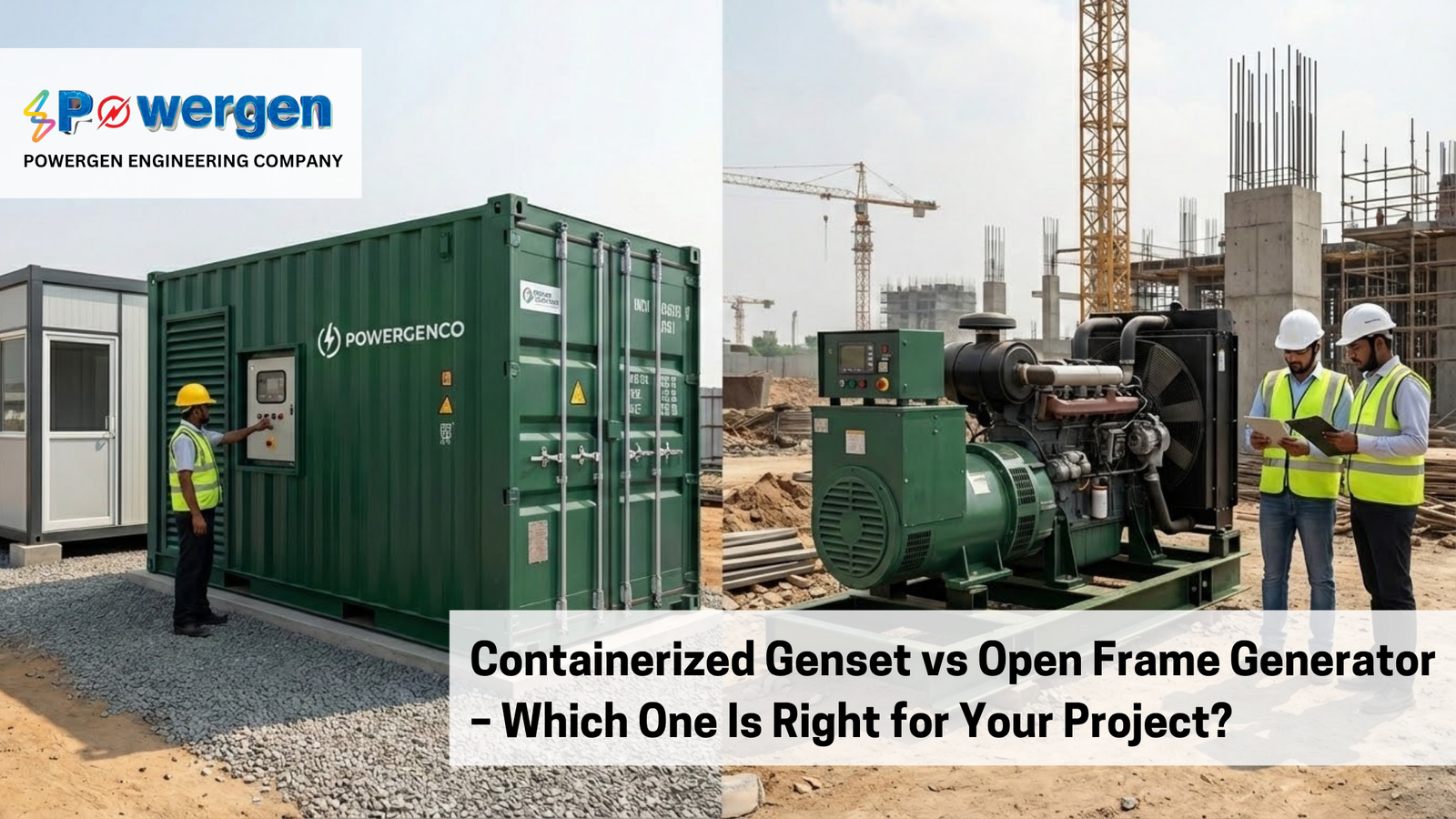
As part of the comparison between containerized genset and open frame generators, it can be noted that containerized genset entails the installation of the diesel generator set inside the container, which is made based on the ISO standard for steel containers. The containers may come in various sizes, such as 10 feet, 20 feet, and 40 feet, depending on the power output of the generators placed in the container. Contrary to the ordinary container, which covers the generator set, the container has the facilities needed by the generator set.
Core Construction Features
- Material of enclosure: High-carbon steel with either galvanized or epoxy-coated internal surfaces for protection against rust
- Ventilation system: Forced ventilation systems with air inlet and outlet baffles designed according to the cooling needs of the generator
- Soundproofing: Internal mineral wool or foam insulation lowers the noise level to 70 to 85 decibels
- Fuel storage: Integrated fuel tanks with capacities varying between 500 and 5,000 liters for extended operations
- Structural strength: Constructed as per ISO 1496 container specifications for stacking and lifting by cranes
In India, containerized diesel generator sets are commonly used in telecommunications towers located away from urban centers, mining sites, offshore service facilities, export projects, and construction sites for which the erection of a civil building to house a generator is uneconomical.
What Is an Open Frame Generator?
In the genset vs open frame generators comparison, an open frame generator can be considered the simplest structure design for a diesel generator set, as compared to a containerized unit, which does not have any protective enclosure. The engine, alternator, fuel systems, and base frame are completely exposed to the outside environment in an open frame generator.
An open frame genset vs containerized genset scenario usually involves the generator being fitted on a strong, welded steel skid, which serves as the foundation of the whole generator set. The skid acts as the support to the engine, alternator, radiator, fuel tank, and vibration isolators, as well as lifting points. The generator’s control panel/switchboard is often mounted directly on the skid or a panel frame located nearby.
Due to its exposure to the environment, an open frame generator is typically mounted in generator rooms or power houses, as well as other industrial facilities that offer protection against weathering, dust, corrosion, and extreme temperature conditions, since they are already built-in features of these structures. When deciding on containerized genset vs open frame generator installations, this type of arrangement is usually employed for industrial sites, large commercial buildings, and fixed permanent facilities.
The fact that open frame units are exposed to their surroundings results in the necessity to conduct extensive site planning when considering containerized genset vs open frame generator installations. This is because special ventilation, noise abatement, and weatherproofing must be considered independently for such units. It is often the case that containerized genset vs open frame generator selection is made based on the need for portability and environmental protection in temporary applications.
Core Construction Features
- Frame: Robust, heavy-duty steel frame mounted on vibration-absorbing supports
- Accessibility: Full access to all parts of the engine and alternator for servicing
- Cooling system: Direct air-cooling using radiators without any baffles in between
- Output noise: 85 to 100 dB within one metre from the generator
- Size: Reduced size compared to a comparable power generator housed in a containerized system
Open-frame generators are a common feature in industrial complexes equipped with a generator room according to IS 3217, manufacturing plants, construction sites that have temporary shelters, and agriculture-based settings with no restrictions regarding noise levels.
Containerized Genset vs Open Frame: Head-to-Head Comparison
| Parameter | Containerized Genset | Open Frame Generator |
|---|---|---|
| Environmental protection | Full IP-rated enclosure, rain and dust sealed | None. Requires a separate civil structure |
| Noise output | 70 to 85 dB at 1 m with acoustic lining | 85 to 100 dB at 1 m |
| TNPCB / urban compliance | Achievable with correct specification | Non-compliant in most urban zones |
| Mobility | Crane or flatbed deployable as a single unit | Transportable but requires dismantling and reassembly |
| Installation time | Hours, not days. No civil works required | Days to weeks, depending on civil structure requirements |
| Maintenance access | Restricted to access panels and doors | Unrestricted from all sides |
| Upfront cost | 20 to 40% higher than the open frame equivalent | Lower initial capital cost |
| Fuel autonomy | Built-in sub-base tanks available | Requires separate fuel storage infrastructure |
| Salt air/corrosion risk | Container structure provides barrier protection | Fully exposed. Accelerated corrosion in coastal zones |
| Application fit | Remote, outdoor, export, mobile power plant | Dedicated generator room, industrial campus |
When a Containerized Diesel Generator Is the Right Call
The container design addresses particular operational concerns that could not be solved by the open frame system without large-scale civil engineering efforts.
Remote and Off-Grid Sites
Rajasthan mining sites, Northeast telecom towers, and Andaman offshore structures face a shared problem of lacking any permanent structure. In India, the Powergen containerized diesel generator arrives fully operational in the same ISO container in which it ships. It does not need a generator room, a roof, or walls. The ISO container itself serves as the civil structure.
Export and International Projects
It is standard practice to use containerized systems for African and Southeast Asian infrastructure development programs. The ISO container design plugs directly into international shipping channels. When shipped to Kenya and Myanmar program locations, the Powergen containerized genset is loaded into the standard shipping container space and delivered fully operational. Learn more about containerized genset configurations at powergenco.in/products/
Mobile Power Plant Requirements
Repositioning will be needed several times in the course of its lifetime for the provision of event facilities, emergency services operations, and temporary industrial camps. This type of power plant can be lifted using a crane, transported to its destination, and put back into operation within a few hours. This cannot be done with the open-frame model without removing the engine and exhaust.
Coastal and High-Humidity Environments
Generation facilities situated 3 to 5 km from the Indian coast will suffer from sea air corrosion of generator parts that is 5 to 10 times faster than in the interiors of India. An example can be seen in the industrial area in Chennai, located between Manali and Ennore along the coast. In this regard, the container serves the purpose of providing a protective structure that a standard genset enclosure does not provide. The container is built with galvanized interior surfaces and marine-grade exterior painting.
When an Open Frame Generator Makes More Sense
An open frame design does not have to be a less desirable option. There are cases where an open frame generator would prove to be a better choice for an industrial setting than its containerized counterpart. The critical element in deciding between containerized and open frame systems is the location of the installation and the environment that exists there.
An open frame generator is more suitable if the installation is located in an enclosed structure such as a generator house or power house. These buildings already provide protection from the elements against rain, dirt, corrosion, and excessive heat due to sun exposure. Thus, the added enclosure provided by a containerized system would no longer be necessary.
However, in the case of comparison between containerized gensets vs open frame generators, open frame generators are also recommended when maintenance access is easy. The complete access to the engine, alternator, and accessories makes the process quicker and allows the technician not to work inside a restricted area.
One more example of the scenario where containerized genset vs open frame generators should be evaluated based on other factors is the installation of generators in a big plant that has a complex electrical system. Open frame generators allow the designer to have more freedom when placing the generator and installing an air vent or exhaust ducts.
When it comes to permanent installations in industries, power stations, data centers, or other large buildings, the choice leans towards open frame generators.
Permanent Indoor Installations With Dedicated Generator Rooms
Hospitals in Adyar, data centres in OMR, or factories in Ambattur that have a well-built generator room according to IS 3217 requirements do not require containers. The civil construction acts as the environmental shield, and the open frame generator offers easy maintenance and lower initial capital outlay with this environment in place.
Very Large KVA Requirements
In cases where power exceeds 1,000 KVA, the open frame type is more prevalent since it would be difficult to transport a containerized unit of that size. High-voltage diesel generators operating at voltages of 3.3 kV, 6.6 kV, and 11 kV can be arranged in open frames inside substations. See Powergen’s high voltage generating sets at powergenco.in/products/
Sites With Controlled Ambient Conditions
If the facility offers shelter from above, proper ventilation, and limited entry, then there will be no benefit in spending extra money on a container structure, and it would be more logical to opt for an open structure.
Key Technical Factors That Drive the Decision
Thermal Management
There is a thermal problem introduced by the packaging. Thermal management of the engine requires complete heat management via the ventilation system only. Insufficient ventilation leads to heat soak, high coolant temperature, poor engine efficiency, and reduced longevity of the engine. The CEA recommendations for the installation of generators outline the minimum clearances that are necessary, which must be taken into consideration while designing the container.
Generator Derating in Indian Conditions
Both formats are subject to thermal derating in Indian summer conditions. At ambient temperatures of 36 to 38°C, typical across Chennai and central India, a generator derated for climate delivers 85 to 88% of its nameplate capacity. A correctly specified containerized or open frame unit builds in a 15% sizing buffer on top of the calculated running load to account for this. CPCB IV+ compliance requirements apply equally to both formats for all new diesel generators above 5 KVA.
Synchronisation for Large Loads
Projects with power demand above a single generator’s practical capacity use synchronising panels to run multiple units in parallel. This N+1 redundancy architecture works equally with containerized and open frame units. Containerized gensets in parallel operation are common on large construction camps and remote industrial sites where the load varies significantly across shifts.
Regulatory and Compliance Considerations in India
There is a regulatory aspect to the containerized genset vs open frame choice other than noise..
- CPCB IV+ compliance: Compulsory for all new diesel gensets of 5 KVA capacity and above. Either form must comply. Units failing to comply are liable for fines up to Rs. 1 lakh per day, under the Environment Protection Act of 1986
- TNPCB noise standards: 55 dB(A) residential daytime, 65 dB(A) commercial daytime. Gensets with an open frame cannot conform to these standards outside without an acoustic enclosure. An acoustic genset enclosure, or a containerized unit with acoustic lining, is essential for all sites in the Chennai city area
- Fire safety: The installation of diesel generators in India requires NBC regulations compliance with regard to fire separation and extinguishment systems. A genset in a containerized unit with fire suppression makes NBC compliance easier compared to the open-frame genset needing complete construction of the generator room
Conclusion
Choosing a containerized genset against an open frame generator is a matter of site characteristics, legal regulations, transportation requirements, and civil infrastructure. In cases where the installation is to be done remotely, exports are involved, there is an industrial site near the coast, or mobility of power plants is required, containerized diesel generators will offer you the advantage of built-in environmental protection, acoustic compliance, and mobility, which would require extensive civil works for an open frame generator to offer. For permanent indoor installations with a specially designed generator room, the open frame generator will give you the same degree of protection without any additional costs of civil work. Powergen Engineering Company of Kolathur, Chennai, is known for providing containerized gensets and open frame generators ranging from 30KVA to 3,000KVA for various applications, all CPCB IV+ certified. More information can be obtained by visiting our website at www.powergenco.in or contacting us at +91 9840737919.
FAQs
Q1. What is the main difference between a containerized genset and an open-frame generator?
The genset in the container comes with a steel ISO container, which also includes ventilation, acoustic insulation, and weatherproofing. The open-frame genset lacks a casing and needs to be set up inside a special generator room to provide the same level of environmental protection.
Q2. Can an open-frame generator be used outdoors in India?
An open-frame genset can also operate outdoors when placed underneath a temporary shelter; however, it doesn’t come with any weatherproofing, acoustic insulation, or dust-proofing features. Any outdoor genset requires containerization or installation inside a genset enclosure designed to withstand weather and meet the CPCB IV+ and TNPCB standards.
Q3. What does CPCB IV+ compliance mean for containerized diesel generators in India? CPCB IV+ sets emission standards for all diesel gensets that have more than 5 KVA capacity and will be installed after January 2023 in India. The standards will hold irrespective of whether the genset is containerized or an open-frame one. Failure to comply with the standards results in fines of Rs. 1 lakh per day as per the Environment Protection Act 1986.
Q4. Does Powergen Engineering Company supply containerized gensets for remote and export projects?
Yes. Powergen supplies containerized diesel generators engineered for outdoor, remote, and export applications, including projects in Africa and Southeast Asia. Each unit includes weatherproof construction, integrated ventilation, and CPCB IV+ compliance documentation. Full product details are available at powergenco.in/products/.
Q5. What KVA range does Powergen offer for open-frame and containerized generators in Chennai?
Powergen Engineering Company supplies open frame generators from 30 KVA to 3,000 KVA and containerized gensets across custom capacity ranges suited to specific project requirements. Both formats are available with CPCB IV+ certification, factory test certificates, and the manufacturer’s warranty. Contact the team at +91 9840737919 for a project-specific specification.
Q6. Does Powergen offer synchronising panels for parallel generator operation on large projects?
Yes. Powergen supplies generator synchronising panels for parallel operation and N+1 redundancy configurations, compatible with both containerized and open frame generator sets. These panels support automatic load sharing, system stability, and scalable expansion as project power demand grows. Visit www.powergenco.in for further details.