
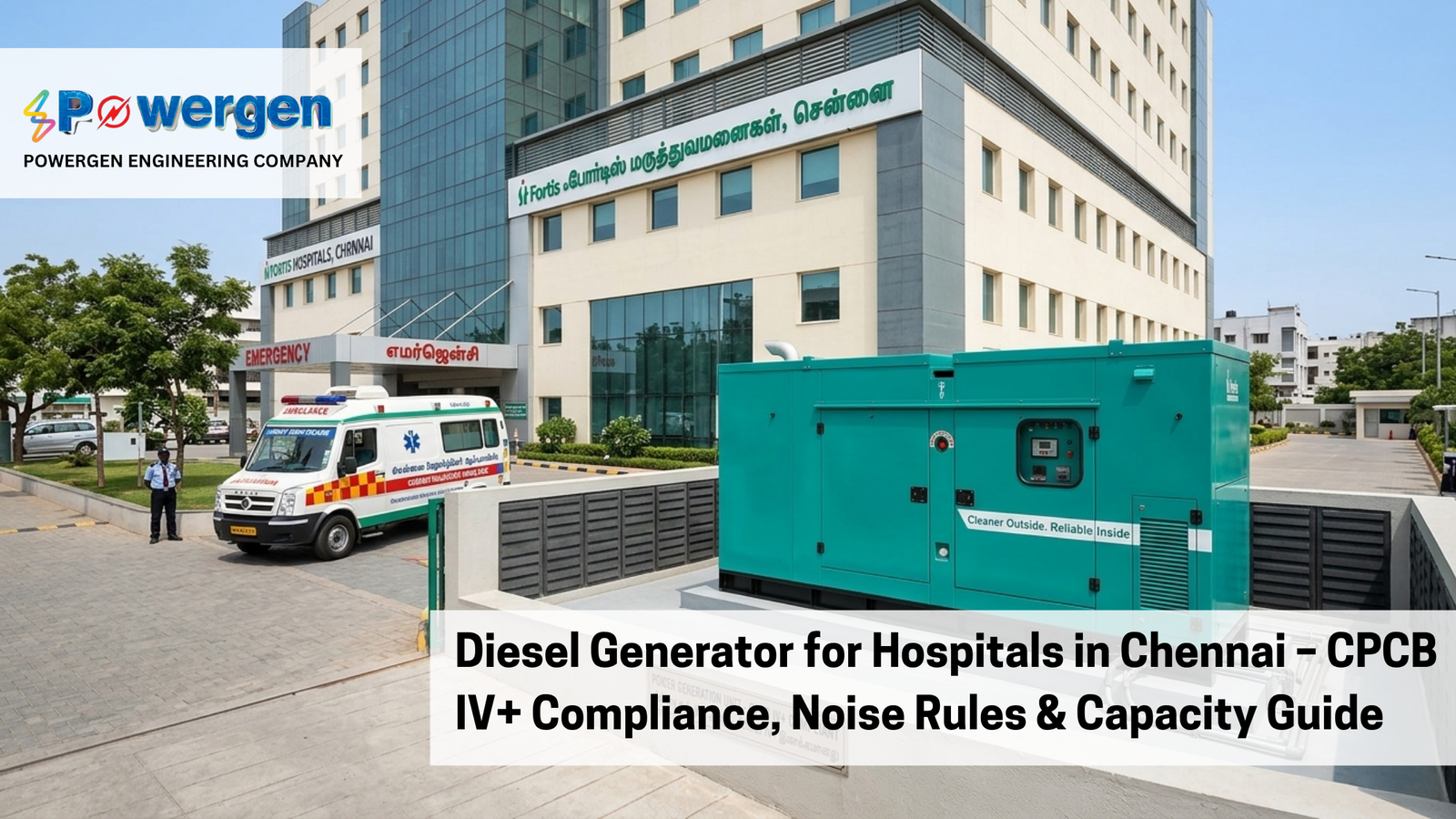
Diesel Generator for Hospitals in Chennai – CPCB IV+ Compliance, Noise Rules & Capacity Guide
Table of Contents
Introduction Diesel Generator for Hospitals in Chennai
Hospital operations take place in an environment where even a slightest disruption in the electricity supply can lead to disastrous consequences. Whether it is about maintaining patients alive through their artificial respirators in the ICU department or operating them using high precision tools in the Operating Theatre, everything requires uninterrupted supply of electricity. Being a city with fluctuations in electricity supply during the rainy season, hospitals in Chennai cannot rule out the possibility of such incidents in peak hours. That makes the requirement of installing a diesel generator for hospitals in Chennai absolutely essential.
This document highlights technical details, IV+CPCB requirements, noise pollution guidelines, and capacity considerations for selecting a diesel generator for hospitals in Chennai.
Why Continuous Power Is Non-Negotiable in Hospitals
Healthcare facilities are considered mission-critical installations in accordance with international electrical standards (NFPA 99 and IEC). Grid failures were established as the major factor causing power-related negative impacts among healthcare facilities in India in 2023, according to research on healthcare power-related incidents. In case of a blackout at a healthcare facility, risks include:
• Health Risks: Life-threatening health risks for patients using mechanical ventilators, infusion pumps, dialysis machines, or ECG monitoring machines.
• Operational Risks: Loss of power affects the functioning of Electronic Health Record systems, PACS radiology information systems, and pharmacy dispensing systems, which can lead to diagnosis or prescription errors.
• Infrastructural Risks: Power failures in blood bank cold chains, HVAC systems in sterile operation theatres, and emergency lighting systems.
It is essential to have a properly sized diesel generator for hospitals in Chennai, capable of delivering an ATS switch within no more than 10 seconds. This requirement aligns with the NFPA 110 Type 10 standard, which should be followed by Indian healthcare facilities such as NABH-accredited hospitals using a reliable diesel generator for hospitals in Chennai.
CPCB IV+ Compliance: What Hospital Administrators Must Know
CPCB IV+ emission norms, incorporated by the notification GSR 804(E) of the MoEFCC on November 3, 2022, are the most stringent emission norms applied to diesel gensets in India so far. In particular, the knowledge of CPCB IV+ emission norms plays a crucial role in choosing diesel generator for hospitals in Chennai.
Adhering to these norms became obligatory for all genset manufacturers from July 1, 2023, meaning that only gensets that comply with them are available on the market. Moreover, sales and installation of CPCB II gensets were forbidden starting July 1, 2024. Therefore, hospitals need to consider upgrading their existing gensets or acquiring CPCB IV+ compliant ones.
In summary, for hospital administrators to choose a diesel generator for hospitals in Chennai, knowledge of CPCB IV+ emission norms is imperative.
Key Pollutants Targeted by CPCB IV+
CPCB IV+ norms mandate significant reductions in the following exhaust pollutants compared to the now-discontinued CPCB II standard:
| Pollutant | CPCB II Limit (g/kWh) | CPCB IV+ Limit (g/kWh) | Reduction |
|---|---|---|---|
| NOx (Nitrogen Oxide) | 9.2 | 0.4 | ~96% |
| PM (Particulate Matter) | 0.3 | 0.025 | ~92% |
| HC (Hydrocarbons) | 0.19 | 0.19 | Maintained |
| CO (Carbon Monoxide) | 3.5 | 3.5 | Maintained |
Technology Requirements for CPCB IV+ Gensets
The process of ensuring CPCB IV+ compliance involves the incorporation of sophisticated post-treatment systems. Any hospital that is purchasing a new genset needs to confirm that the installed genset comprises:
- The use of DOC for oxidation of CO and unburned hydrocarbons.
- The DPF for capturing particulates.
- The SCR system with AdBlue injection for reducing NOx.
- RECD certification issued by an accredited body by the CPCB for gensets up to 800 kW.
Any hospital that continues to run a CPCB II genset faces penalties under the Environment (Protection) Act, 1986, and may receive negative results during accreditation audits by NABH that include environment compliance checks.
Noise Pollution Rules for Diesel Generator for Hospitals in Chennai
It is very clear that hospitals are categorized as “Silence Zones” in India as per the Noise Pollution (Regulation and Control) Rules, 2000. According to these rules, any area within 100 metres radius of hospitals, institutions of learning, and courts of law is considered as a silence zone.
| Zone Type | Daytime Limit (dB) | Night-time Limit (dB) | Applicable To |
|---|---|---|---|
| Silence Zone (Hospital) | 50 dB(A) | 40 dB(A) | Within 100 m of premises |
| Residential | 55 dB(A) | 45 dB(A) | Surrounding areas |
| Commercial | 65 dB(A) | 55 dB(A) | Commercial districts |
| Industrial | 75 dB(A) | 70 dB(A) | Industrial corridors |
Acoustic Enclosure Requirements
The CPCB stipulates that new diesel DG sets up to 1000 KVA must have no more than 75 dB(A) noise levels at 1 metre from the enclosure surface. As hospital sites fall under the category of silence zones, the genset installation should entail:
• A sound enclosure made of noise dampening composite panels (STC-40 rating minimum) to ensure operational noise is below 50 dB(A) at the perimeter of the building structure.
• Anti-vibration mounting pads for isolation from the structural vibrations emanating from the genset baseframe.
• Muffled exhaust systems with residential-grade silencers, with the exhaust stack elevated to at least 6 metres from the building where the genset is located.
• Proper ventilation in the enclosure—CPCB guidelines state that the temperature difference between air within the acoustic enclosure and outside must be no more than 7°C at rated load.
In Chennai, the Tamil Nadu Pollution Control Board (TNPCB) enforces these norms alongside CPCB guidelines. Facilities can refer to the CPCB’s official genset noise compliance system procedure for the latest certification protocols.
Capacity Sizing Guide for Hospital Diesel Generators
Sizing of generators for hospitals is much more complicated than that of commercial buildings, especially when selecting a diesel generator for hospitals in Chennai, where load reliability is critical. The Essential Electrical System (EES) of a healthcare institution is divided into three branches based on their importance and required transfer timing, ensuring that critical medical operations remain uninterrupted at all times.
Branch Classification and Load Mapping
• Life Safety Branch: Emergency lighting, fire alarm control panels, exit signs, medical gas detectors. Must be supplied power within 10 seconds of utility loss.
• Critical Branch: ICU monitoring, ventilators, operating room lights, infusion pumps, nurse call system, emergency department equipment. Also must be supplied within 10 seconds.
• Equipment Branch: Medical air compressor, vacuum pumps, air conditioning for sterile rooms, elevators, some laboratory equipment. Can have somewhat longer transfer time.
Indicative Capacity Reference Table
| Facility Type | Approximate Capacity Required | Recommended Genset Range | Redundancy Config |
|---|---|---|---|
| Small Clinic / Nursing Home (up to 30 beds) | 50–125 kVA | 75–160 KVA | Single unit |
| Mid-size Hospital (30–100 beds) | 200–500 kVA | 250–630 KVA | N+1 |
| Multi-specialty Hospital (100–300 beds) | 500 kVA–1.5 MVA | 630–2000 KVA | N+1 or 2N |
| Tertiary / Teaching Hospital (300+ beds) | 1.5 MVA and above | 2 × 1000+ KVA parallel | 2N parallel |
These numbers are illustrative. Sizing needs to be preceded by proper load studies taking into account the starting inrush currents (normally six to eight times the normal operating current of the motor), power factor correction, and at least 20-25 percent spare capacity for future expansions.
Chennai hospitals installing multiple gensets need to have synchronisation panels installed which will enable load sharing among the different gensets – a feature available from Powergen Engineering Company as a standard fitment in its synchronous genset packages. See http://www.powergenco.in/products.
Key Installation and Operational Compliance Requirements
In addition to emission norms and noise standards, there are other technical norms that need to be strictly followed for installing diesel generator for hospitals in Chennai:
• Capacity of the diesel day tank should be such that fuel lasts for at least 24 hours in case of full load. As regards NABH certified hospitals, TNPCB and CEIG recommend a fuel backup of 48 to 72 hours of diesel availability in case of emergencies.
• Automatic Transfer Switch (ATS) equipment needs to be provided with a load shedding relay, whereby critical and life-saving circuits can be preferred over generator overloading in emergencies.
• Appropriate earthing and bonding as per the standard specifications of IS 3043:2018 (Code of Practice for Earthing) and IS 732 (Code of Practice for Electrical Wiring Installations) are required.
• Test certificate is essential, where test is done according to CPCB norms as per prescribed frequency, say monthly basis, with the minimum runtime of the generator for not less than 30 minutes at more than 30 percent rated load.
• RECD Certificate: A certificate of genset performance is essential for generators with capacity of up to 800 KW.
For more information on genset installation and selection, hospitals considering the use of a diesel generator for hospitals in Chennai can consider the technical details provided in BIS IS 10000 series, which includes specifications related to diesel generator sets for standby/prime power applications.
Conclusion
Installing a diesel generator for hospitals in Chennai needs extensive expertise on CPCB IV+ emission regulations, TNPCB noise regulations, acoustic enclosures, and load-dependent capacity calculation. The consequences can be severe if hospitals in Chennai install gensets that do not conform to these regulations or are underrated. Not only will it affect their clinical responsibilities, but it will also cause them to be held accountable environmentally as per the guidelines set by the concerned authorities and even accreditation organizations. PowerGen Engineering Company (powergenco.in), a Chennai-based expert in the field of providing diesel generators for hospitals in Chennai, provides gensets ranging from 30KVA to 3000KVA, which include CPCB IV+ compliant gensets such as silent gensets, open frame gensets, and containerized gensets, as well as synchronization control panels.
FAQ
1. What is a CPCB IV+ compliant generator?
CPCB IV+ Compliant gensets refer to diesel gensets which have been manufactured with the most recent standards of emissions, released by the Central Pollution Control Board under the MoEFCC notification GSR 804(E). They incorporate the use of DOC, DPF, and SCR technologies and require a valid RECD certificate. Gensets available on the market since July 2024 should have CPCB IV+ certification.
2. Why is hospital power backup so critical in India?
Hospitals in India experience several problems with grid instabilities especially during the monsoons and peak times when there is a huge demand. Medical equipment such as life support equipment, surgical systems, and refrigeration for vaccines and blood are sensitive devices that cannot afford power failures. Therefore, an automated switch and genset become essential to patient health and safety.
3. What are the noise rules for generators near hospitals in India?
According to India’s Noise Pollution (Regulation and Control) Rules of 2000, hospitals are situated in “silence zones” where the allowable ambient noise is limited to 50 dB(A) during the day and 40 dB(A) at night. Hospitals’ gensets need to be fitted with CPCB-compliant sound attenuating covers and should not make more than 75 dB(A) when measured 1 meter away from the enclosure surface.
4. Does Powergen Engineering Company supply CPCB IV+ compliant generators for hospitals in Chennai?
Yes. Powergen Engineering Company supplies CPCB IV+ compliant silent diesel gensets from 30 KVA to 3000 KVA, specifically suited for hospital applications in Chennai and across Tamil Nadu.
5. What generator capacity does a 100-bed hospital in Chennai typically require?
A 100-bed hospital in Chennai typically requires a genset capacity in the range of 500–750 KVA after factoring in ICU, OT, HVAC, and diagnostic loads, plus a 20–25% growth headroom. Powergen recommends a formal load analysis before finalising the specification. Contact the team at www.powergenco.in/contact-us for a site-specific assessment.
6. Can Powergen assist with TNPCB documentation and acoustic enclosure compliance in Chennai?
Yes. Powergen Engineering Company offers complete assistance from unit supply certified by CPCB IV+, acoustic enclosure design, ATS installation, and assistance in obtaining TNPCB permission to operate. Please visit our website www.powergenco.in or contact us at +91 9840737919.