
How Generator Synchronizing Panels Work – Load Sharing, Redundancy & When You Need One
Table of Contents
Introduction
Generator Synchronizing Panel India Over the past ten years, the power generation systems for industrial as well as commercial establishments have become much more sophisticated in India. Industrial manufacturing units, IT/data centres, hospitals, and other big buildings have discovered that even if it may be one of any capacity, just relying on one diesel generator set will not be enough to meet their needs of availability, redundancy, and scalability. This calls for multiple generators working in tandem, controlled through an appropriately designed generator synchronization panel that is used in India.
The present article discusses in depth the technical aspects associated with a generator synchronization panel that India-based installations depend upon – including synchronization criteria, load sharing mechanisms, AMF and ATS integration, redundancy options, and situations under which it makes sense to go for a synchronization panel.
What Is a Generator Synchronizing Panel?
A generator synchronization panel is an electrical control system designed specifically for the purpose of ensuring the synchronization of two or more generator sets or a generator set along with the utility system by constantly checking electrical parameters prior to closing a circuit breaker. More technically speaking, it can be defined as an ANSI Relay 25 device with load sharing and protection relays incorporated within the same switchgear assembly.
The panel houses the following core functional blocks:
- Synchronising Controller / Module: A controller using a microprocessor, which constantly monitors the voltage, frequency, and phase angle of both the generator to be synchronised and the live busbar and sends commands to the Governor and AVR (Automatic Voltage Regulator) until the two match within programmable margin limits.
- Synchronisation Relay or Sync-Check Relay (ANSI 25): It acts as the final hardware check, i.e., it allows GCB/BTB closing only if the differences in voltages, frequencies, and phase angles are within the specified margin, irrespective of the output signal from the synchronising module.
- Load Sharing Module: After parallel operation of generators in the common busbar network, this module ensures proportional loading of active and reactive powers (in kW/kVAR) among all generators online.
- Relay Protection System: Reverse Power Relay (ANSI 32), Voltage Over/Under Relay (ANSI 27/59), Frequency Over/Under Relay (ANSI 81), and Differential Protection (ANSI 87) to disconnect a malfunctioning component without affecting other parts of the system.
- Air Circuit Breakers (ACBs)/Moulded Case Circuit Breakers (MCCBs): Automated breakers for each generator’s incoming line and main busbar feeder lines regulated by the synchronisation process.
Pre-Synchronisation Conditions: The Four Parameters
For the parallel operation of two AC generators, there should be agreement in four electrical characteristics simultaneously. A synchronisation control panel designed by Indian engineers would constantly check these four criteria before closing the breaker.
| Parameter | Typical Tolerance | Controlled By | Effect of Mismatch |
|---|---|---|---|
| Voltage (RMS) | ±5% of bus voltage | AVR adjustment | Circulating reactive current, overheating |
| Frequency (Hz) | ±0.2 Hz | Governor speed trim | Power surges, rotor stress |
| Phase Angle | Within ±10° | Synchroniser ramp | High inrush current, mechanical shock |
| Phase Sequence | Must be identical (R-Y-B) | Verified at commissioning | Severe fault current, equipment damage |
A modern synchroniser can perform this task automatically in less than 10-30 seconds for the majority of diesel-generator set combinations. The ANSI 25 synchronizer checker verifies all four criteria individually before the breaker closure, acting as an additional safety feature in case of failure of the synchroniser.
How Load Sharing Works in Parallel Generator Systems
The moment that two or more generators become paralleled via the same busbar, the load-sharing function of the generator synchronization panel that India-based installations rely upon assumes control. The process can be accomplished via one of two main approaches:
Droop Load Sharing
This technique is currently the most used technique in India to perform parallel operation on Diesel gensets. The governor of each genset is set such that it has a droop value ranging between 3% to 5%. This implies that when the load on each genset increases, the engine’s speed decreases. In case of two similar generators having similar droop value, that generator whose load exceeds the other generator runs at a slightly reduced speed, hence reducing its output, while the other increases automatically.
This results in automatic proportional load sharing in the absence of any communication between units. In case the generators have different capacities, i.e., in case of two gensets, one having 1000 kVA and the other 630 kVA, the load sharing module sets the droop values in proportion to their capacity ratings.
Isochronous Load Sharing (ILS)
In the case of isochronous control mode, all the generators in the parallel set are required to share the load and maintain their rated frequency exactly (in India 50 Hz) without having any droop. This can be done using communication among units, either by way of a dedicated load-sharing bus or by means of CANbus/Modbus digital communication, where information regarding kW output of each generator is exchanged with other generators. The ILS method offers better frequency control but demands compatibility between the controller hardware of all the generators.
Automatic Load-Dependent Start/Stop (LDSS)
The LDSS logic is used in the modern synchronizing panels. In case the load becomes lower than the preset percentage (usually 60-70% of the available capacity), the panel automatically reduces the number of gensets by one, synchronizes it off, and stops it in order to save fuel. When the load rises, the panel switches on the spare unit, synchronizes it, and connects its GCB without any manual actions from the operator. The function is especially useful in plants with varying production rates.
AMF Panel and ATS Integration with the Synchronising Panel
In commercial and industrial installations in India, the synchronizing panel that is used always comes together with an AMF panel or Automatic Transfer Switch in order to form an automated system for managing electrical power. The need to know about the differences between these panels, as well as their integration, becomes very important.
| Panel Type | Primary Function | Typical Application | No. of Sources Managed |
|---|---|---|---|
| AMF Panel | Detects mains failure; starts genset; transfers load to DG | Single genset + utility | 2 (Mains + 1 DG) |
| ATS Panel | Automatic load transfer between two power sources | Single genset + utility | 2 (Mains + 1 DG) |
| Synchronising Panel | Parallels multiple DGs; manages load sharing and redundancy | Multi-genset systems | 2 or more DGs ± utility |
| AMF + Sync Combo | Full automation: mains fail → multi-DG start → sync → load share | Critical infrastructure | Mains + 2 or more DGs |
The operation proceeds in the following manner when the combination of the AMF and the Synchronising panel is used together: the AMF controller is constantly checking the three-phase power supply from the utilities for the availability of voltage, frequency, and correct phase sequence. Upon detection of any loss of mains supply (with a pre-programmable time delay of 3-10 seconds to prevent the nuisance starting caused by the fall in voltage), all the generator sets are started simultaneously. All of them are started and made to operate at operating speed, and thereafter, the synchronising panel connects the first unit to the dead busbar (without synchronising because of the connection with the dead bus) and then synchronises all subsequent units onto the busbar by ANSI 25 permissive. When the load is being shared equally, and the required number of units are paralleled, the system sends a signal for the load to be connected to the ATS/motorised mains incomer. In case of restoration of mains supply, reverse operations are performed in sequence.
For detailed technical specifications on AMF and synchronising panel combinations, refer to IS 8544 (Indian Standard for switchgear and controlgear) and the BIS IS 10000 series for DG set control systems.
Redundancy Configurations: N+1, 2N, and N+2
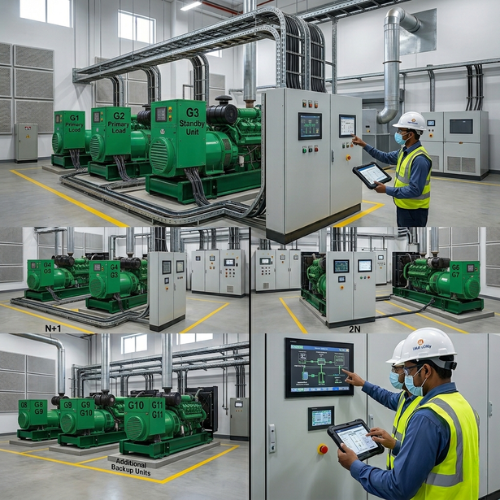
Among the main reasons for acquiring a synchronising panel from an engineering perspective is the provision of redundancy schemes. Three basic options are chosen based on whether or not an outage is acceptable at a site:
- N+1 Redundancy: This design involves using N gensets to generate power to cover the load requirement, but with another unit ready to be put into service in case any of the other N units fail due to a fault. This type of design is common among hospitals, pharmaceuticals, and major commercial complexes in India
- 2N (Full Redundancy): Here, two separate systems are created for generating electricity, with each able to provide all the load power requirements. These are usually applied in Tier 3 and Tier 4 data centres and other critical defence/government infrastructure.
- N+2 Redundancy: The presence of two spare units apart from the minimum number of gensets needed for covering the load requirement makes this design applicable for offshore rigs, petrochemical complexes, and highly critical manufacturing sites.
The synchronizing panel represents the enabler in each of the three scenarios. In its absence, automatic failover from one generator to another, within the 10-second switching period as dictated by the NABH standards for hospital EES or SLAs for data centres, would be impossible to accomplish.
When Does a Facility Need a Generator Synchronizing Panel?
Every genset setup does not need a sync panel. A single genset unit with an AMF panel is enough for small setups where loads do not have critical requirements. The generator synchronizing panel India installations need the following situations:
- When total load demand surpasses the power supply capability of the most powerful commercially available or deployable single genset (normally more than 2500 KVA in usual cases).
- When critical loads such as ICU machinery, CNC milling units, server racks, and cleanroom HVAC systems must continue running without even a ten-second interruption between gensets’ transfers.
- For scheduled maintenance, one genset needs to be powered off while continuing a 100 percent power supply to loads.
- The facility’s energy demand varies substantially from one shift to another or season to season; hence, Load Dependent Start/Stop will be cost-effective in ensuring the reduction of diesel fuel and maintenance of the gensets.
- The facility is being developed in stages, and there is an intention to increase generator capacity gradually without changing the big generator.
- Compliance with certain regulations like NABH hospital, LEED buildings, and TNPCB consent to operate requires a minimum of N+1 redundant generators.
Conclusion
The synchronizing control panel for a generator is an advanced engineering innovation in the domain of power generation that converts separate diesel generators into a highly efficient, redundant, and effective power system. The innovative device takes care of parameters involved before synchronization, load sharing using the principle of droop speed control, automation of automatic mains failure, and N+1 redundancy management. The innovative solution meets the requirements of India’s most critical infrastructures. For the evaluation of multi-generator power systems at facilities located in Chennai, as well as other parts of Tamil Nadu, Powergen Engineering Company (powergenco.in) offers synchronizing control panels as a part of its range of diesel generators, with capacities ranging from 30 KVA to 3000 KVA.
FAQ:
1. What is a generator synchronizing panel?
The generator synchronizing panel is an electronic control unit that synchronizes the voltages, frequency, phase angles, and phase sequence of at least two power sources prior to synchronizing and paralleling the same. It allows for safe paralleling of diesel generators and equal load-sharing among the generators once they have been paralleled.
2. What is the difference between an AMF panel and a synchronizing panel?
Whereas the AMF panel handles the automatic startup and transfer of a single generator in case of failure of the mains supply, the synchronizing panel can handle the synchronization of two or more generators, allowing them to work together. Both panels are commonly found together in critical establishments in what is referred to as an AMF + Synchronizing panel.
3. What is droop load sharing in parallel generators?
The droop load sharing principle is a load sharing mechanism that is self-regulated by the generator’s governors, being designed such that they lower the engine speed as the load increases. Droop load sharing requires that two or more generators that have been programmed to have identical droop be able to share active load equally proportional to their capacities.
4. Does Powergen Engineering Company supply synchronizing control panels along with generator sets?
Absolutely. The company, Powergen Engineering Company, provides synchronizing control panels, which are included in their range of diesel generator sets from 30 KVA to 3000 KVA, including both standard and customised parallel operation setups.
5. Can Powergen supply a generator synchronizing panel for an existing genset installation in Chennai?
Yes. Powergen Engineering Company can engineer and supply standalone synchronising panels for retrofitting into existing multi-genset installations in Chennai and across Tamil Nadu. Contact the team to discuss your site’s specific controller compatibility and busbar configuration requirements.
6. What industries in Chennai typically require a synchronizing panel from Powergen?
Synchronizing Panels from Powergen are used by hospitals that require N+1 redundant power supply to get NABH certification, manufacturing units with varying load requirements, data centres, textile factories, and large commercial establishments in Chennai & Tamil Nadu. For an overall view of all products offered by Powergen, visit Powergenco.