
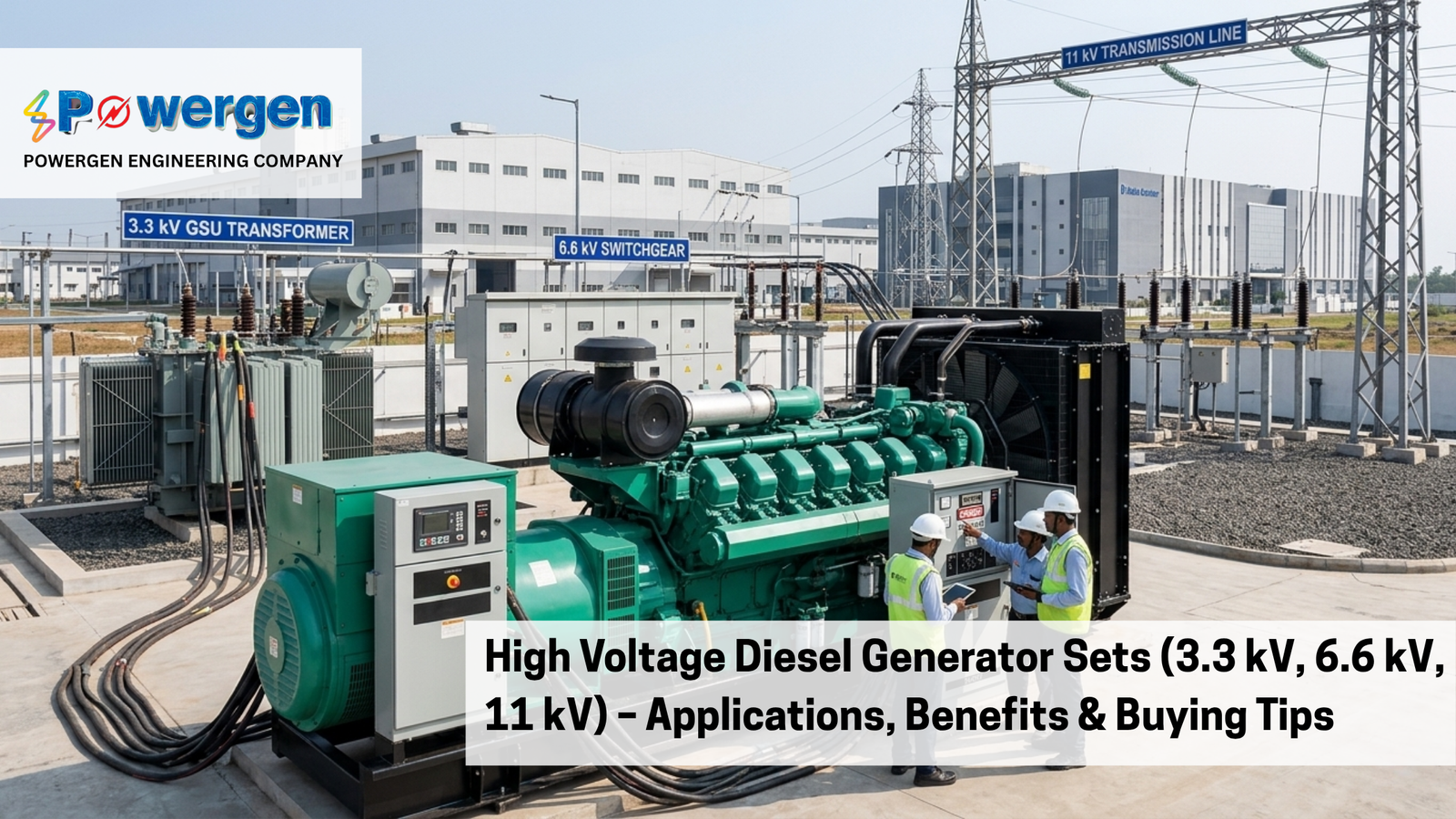
High Voltage Diesel Generator 11kV India 2026 – Applications, Benefits and Buying Guide
Table of Contents
High voltage diesel generator 11kV India is now more commonly chosen within the rapidly expanding industries of India, including petrochemical refining facilities, steel plants, cement production plants, drilling platforms at sea, and large-scale construction sites, where the conventional diesel generator set at low voltage 415 V comes up against its physical limitations long before it could meet the requirements for the distribution of electrical power in major manufacturing units. The moment that the magnitude of equipment involved exceeds 1500 to 2000 kVA, or the moment that it becomes necessary to distribute electricity over greater distances within a plant beyond a few hundred meters, the high voltage diesel generator in India, particularly at voltages of 11kV, as well as medium voltage diesel generator sets at 3.3 kV and 6.6 kV, are selected.
This is where the High voltage diesel generator 11kV India market becomes critical for large-scale industrial applications requiring efficient and stable power distribution.
This guide provides an overview of why engineers choose medium and high voltage generators, the voltages used in Indian industry, their advantages over low voltage generators, their industrial applications, and the important factors that need consideration when selecting a High voltage diesel generator for 11kV India projects need.
Understanding Medium and High Voltage Generation in the Indian Context
Power distribution in India follows standardized voltages as per the Central Electricity Authority (CEA), which corresponds to the IEC 60038 standard. The following are the standardized voltages for captive and standby diesel gensets:
| Voltage Class | Rated Output (Line-to-Line) | Typical Capacity Range | Indian Industry Application |
|---|---|---|---|
| Low Voltage (LV) | 415 V (3-phase) | 30 KVA – 2500 KVA | Commercial buildings, hospitals, small industries |
| Medium Voltage (MV) – Low Tier | 3.3 kV | 1000 KVA – 2500 KVA | Textile mills, food processing plants, small refineries |
| Medium Voltage (MV) – Mid Tier | 6.6 kV | 1500 KVA – 4000 KVA | Cement plants, steel rolling mills, petrochemical units |
| High Voltage (HV) | 11 kV | 2000 KVA – 5000+ KVA | Mining, offshore platforms, power plant auxiliaries, large industrial campuses |
In practical terms, the concept of High voltage diesel generator 11kV India applies to all generators that can supply electricity at voltages greater than 1 kV from the terminals of the alternators themselves, without any additional transformer for stepping up the voltage. It is this very feature of compatibility that forms the basis of the entire HV genset concept, especially in large-scale High voltage diesel generator 11kV India industrial applications.
How a High Voltage Diesel Genset Generates at 11 kV India
In a conventional low-voltage diesel generator set, there is a diesel engine connected to a 415 volts synchronous generator. A typical High voltage diesel generator 11kV India system used in industries operates in a similar manner, where a diesel engine is coupled to a generator designed to operate in medium voltage systems of 3.3 kV, 6.6 kV, or 11 kV.
In a High voltage diesel generator 11kV India configuration, the alternator is specifically engineered with higher insulation levels, robust winding design, and advanced voltage regulation systems to directly deliver power at higher voltages. This allows industries to efficiently distribute power across large facilities without the need for step-up transformers, reducing transmission losses and improving overall system efficiency.
HV Alternator Construction
HV Alternators have a number of differences in their insulation technology as compared to that in low voltage (LV), especially in a High voltage diesel generator 11kV India system:
Stator Winding Insulation: The HV alternators employ either Class F (155°C) or Class H (180°C) epoxy mica tape in conjunction with Vacuum Pressure Impregnation. End turns and slot portions receive anti-corona coatings to avoid partial discharge, which is peculiar only above 1 kV.
Rotor Construction: Triple-insulated rotor winding construction ensures that there is no turn-to-turn and layer breakdown because of high rotor rotation forces. End winding bracing is strengthened to withstand any possible deformation due to a short circuit.
Ingress Protection and Ventilation: Normal IP23 radial axial ventilation; IP44 or IP54 can be arranged as required, to suit Indian coastal and humidity-prone environments.
THD and TIF Performance: Properly designed HV alternators keep their Total Harmonic Distortion (THD) <2% and Telephone Interference Factor (TIF) <50.
Protection Relay Requirements
As opposed to LV generators, which rely on a basic MCCB for overcurrent protection, high-voltage gensets running on 11 kV need a protection relay suite. In a High voltage diesel generator 11kV India system, these will comply with IS 3427 (Metal-enclosed switchgear for voltages above 1 kV up to 36 kV) and IEC 62271-200. The following protection functions are mandated:
ANSI 87G – Generator differential protection: Detects stator faults by comparison of measured currents at each end of the winding; high speed ensures minimal winding damage.
ANSI 51V – Voltage-controlled overcurrent: Secondary protection for situations when terminal voltage drops below the acceptable limit.
ANSI 40 – Loss of field (out-of-step): Ensures the excitation system is operational in order to prevent overheating of the stator windings.
ANSI 59/27 – Over/Under-Voltage: Ensures protection of downline components and alternator windings from excessive voltages.
ANSI 81 – Over/Under-Frequency: Prevents working above or below the permissible frequency range, i.e., 47.5 to 51.5 Hz, according to the Indian Central Electricity Authority guidelines.
Earth fault protection: Either a high impedance or low impedance earthing is provided at the neutral according to the system fault level and earthing philosophy as per IS/IEC 60071-1 (Insulation coordination).
Engineering and Commercial Benefits of HV Diesel Gensets
Reduced Transmission Losses via the I²R Principle
The basic electrical equation that determines the efficiency of the transmission system is Power loss = I² × R. In case there is a specific load in kW and the transmission voltage is increased by N times, then the current is reduced to N times, and the transmission losses are reduced by N² times.
In a high voltage diesel generator 11kV India application, this principle becomes highly practical for large industrial loads. If 2000 kW of power is to be transmitted using 11 kV, it will require about 105 Amps per phase. If the same power is to be transmitted using 415 V, then it will require about 2780 amps per phase.
This clearly shows that the losses in cables using 415 V would be approximately 676 times higher than the losses at 11 kV, making high voltage distribution far more efficient, especially for large industrial plants and long-distance internal power distribution.
Elimination of the External Step-Up Transformer
Where there is the need for power distribution up to 11 kV, an LV genset requires the installation of a step-up transformer (Generator Step-Up or GSU transformer) between the genset and the HV switchgear. In a High voltage diesel generator 11kV India system, this transformer becomes unnecessary, offering several engineering and commercial advantages:
- Reduction in capital costs: GSU transformers are major cost elements for gensets in the 2–5 MVA capacity range.
- Saving of space: Plant substations often have limited space, and eliminating the transformer frees up valuable area.
- Reduction in transformer losses: Typical transformer losses range between 0.5% and 1.5% of rated power, leading to measurable fuel savings over the genset’s operational lifetime.
- Simplification of protection coordination: Removing the transformer impedance layer simplifies the single-line diagram and improves overall system design efficiency.
Smaller Cross-Section HV Cables
Lower current in HV systems allows for the use of XLPE cables with a much smaller cross-sectional area (as per IS 7098 Part 2 for voltages ranging from 3.8/6.6 kV to 19/33 kV). In a high voltage diesel generator 11kV India setup, this reduction in current significantly decreases the conductor size required for efficient power transmission.
In large industrial complexes such as petrochemical plants, mining operations, and cement manufacturing units, where cable routing distances are extensive, this advantage becomes highly critical. The reduction in copper or aluminium usage not only lowers initial material costs but also simplifies installation, handling, and cable tray design. In many real-world scenarios, the savings achieved on cabling infrastructure alone can offset the additional cost of implementing a High voltage diesel generator 11kV India system compared to a conventional LV generator.
Scalability and Parallel Operation
HV gensets are ideal for parallel operation using an HV synchronizing panel and a common 11 kV busbar. In a High voltage diesel generator 11kV India system, this setup supports reliable configurations such as N+1 and 2N redundancy for critical applications.
To increase power capacity, an additional genset can be integrated with the existing HV switchgear using an incomer circuit breaker. This makes a High voltage diesel generator 11kV India solution highly scalable, without requiring extra transformers or major structural modifications.
Key Industrial Applications of 3.3 kV, 6.6 kV & 11 kV Gensets in India
| Industry Sector | Typical HV Voltage Used | Primary Use Case | Critical Load Examples |
|---|---|---|---|
| Petrochemical & Refining | 6.6 kV or 11 kV | Prime or standby power for process units | Compressors, boiler fans, cooling towers |
| Mining & Quarrying | 3.3 kV or 6.6 kV | Remote site power generation | Draglines, crushers, ventilation fans |
| Cement Manufacturing | 6.6 kV | Captive power plant auxiliaries | Kiln drives, ball mills, raw material conveyors |
| Offshore / Marine | 6.6 kV or 11 kV | Platform and vessel prime power | Subsea pumps, drilling drives, life safety systems |
| Power Plant Auxiliaries | 11 kV | Emergency/black-start diesel genset | Cooling water pumps, ID/FD fans, lighting |
| Large Industrial Campuses | 11 kV | Campus-wide standby power distribution | HVAC, production lines, data systems |
Key Technical Parameters and Buying Tips for HV Diesel Gensets
High voltage diesel generators in India industrial projects have higher technical and compliance requirements compared to low voltage diesel generators. In a High voltage diesel generator 11kV India application, factors such as insulation design, protection systems, and voltage stability become critical for reliable long-term operation.
The following aspects need to be clearly defined and verified when selecting a high voltage generator:
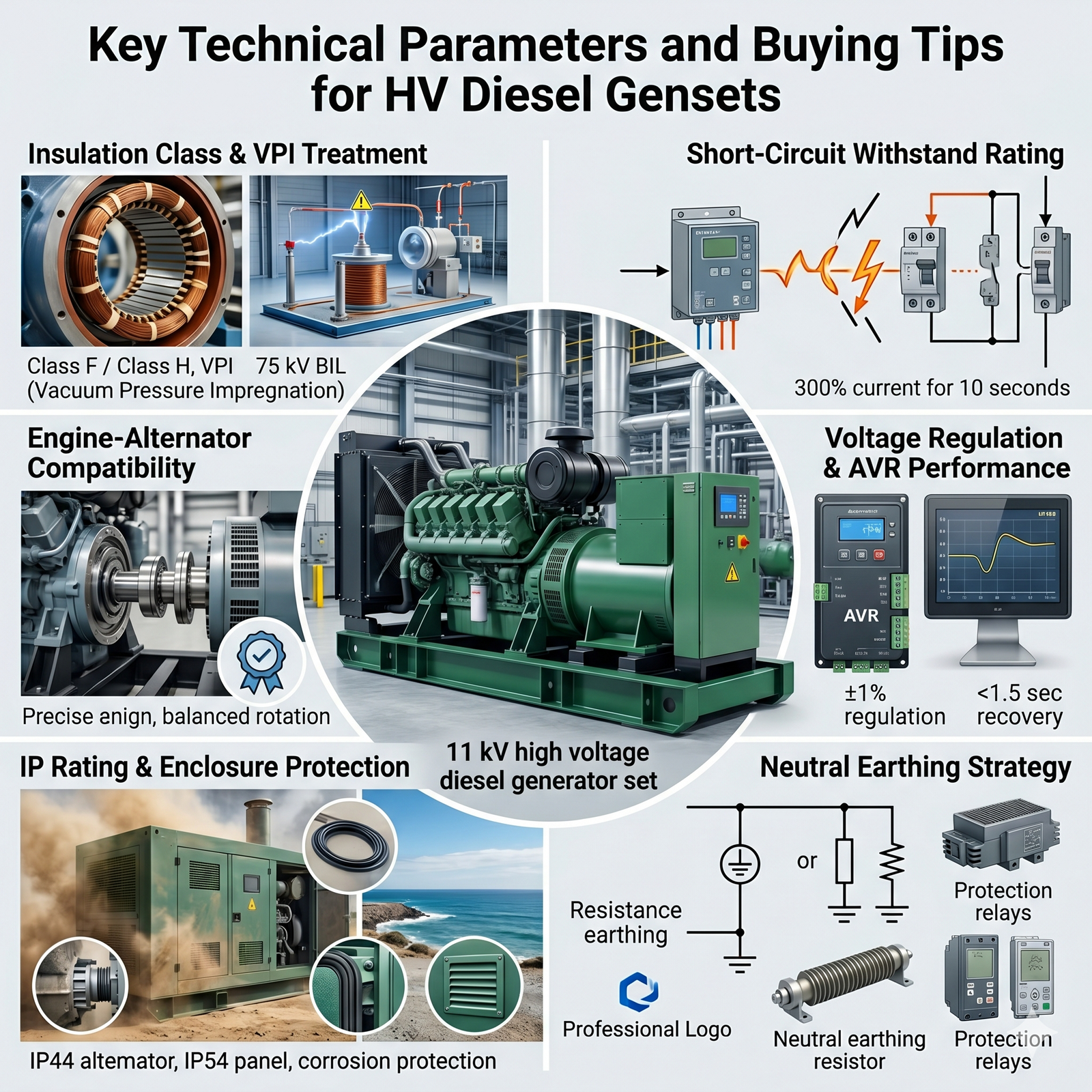
1. Insulation Class and VPI Treatment
Class F or Class H stator insulation with VPI insulation should be used. Get a certification for Dielectric Withstand test (DWI). It assures that the winding can withstand the impulse voltages as indicated by IS/IEC 60071-1 standards for the voltage level concerned. If the generator voltage rating is 11 kV, then BIL will be 75 kV peak.
2. Short-Circuit Withstand Rating
A high voltage generator should be able to withstand a short circuit current rating of 300% of rated current for 10 seconds without winding distortion. This is the standard for industrial HV application according to IEC 60034 (Rotating Electrical Machines). Winding damage may result if such requirement is not satisfied, especially at faults in downstream equipment.
3. Voltage Regulation and AVR Performance
Design the AVR with steady state voltage regulation of ±1% and recovery time of less than 1.5 seconds for a step load change of 100%. Such performance criteria are necessary for starter applications, which are quite prevalent in heavy industries of India.
4. Neutral Earthing Strategy
While LV systems normally have solid earthing in practice, the genset neutrals need a well-defined policy in terms of earthing, whether by solid, resistance, or high impedance earthing methods. Depending on the mode chosen, the levels of fault current, relay settings, and other issues will differ. It is advisable to engage a system protection engineer in defining the type of earthing needed in your case prior to procurement.
5. IP Rating and Enclosure Suitability for Indian Conditions
In the case of projects near coastal areas in Tamil Nadu or dusty places like cement and mining plants, ensure that the alternator is at least IP44 rated and any control panels are IP54 minimum. Copper busbars, terminals, and switchgear can also be specified as certified corrosion-proof if within 5 km of the coast.
6. Engine-Alternator Compatibility Certification
Approval by the engine manufacturer for use of the particular alternator drive system is required and should be provided. Torsional resonance due to imbalance of inertia moments on the engine flywheel and the high-voltage alternator rotor may result in shaft breakage, which is more devastating at high voltage because of greater mechanical stress.
Regulatory and Standards Compliance in India
Requirements for obtaining a High voltage diesel generator 11kV India installation:
- CPCB IV+ Emission Norms (GSR 804(E), Nov 2022): Applies irrespective of the output voltage of the diesel engine. All gensets manufactured after July 2023 should have an RECD certificate issued by a CPCB authorized body.
- IS 3427: Metal Enclosures for Switchgear and Controlgear Rated Voltage Above 1 kV and Up to and Including 36 kV – Applicable to HV switchgear to be installed for genset output.
- IS/IEC 62271-200: AC Metal-Enclosed Switchgear and Controlgear for Rated Voltages Above 1 kV and Up To and Including 52 kV.
- CEA (Measures Relating to Safety and Electricity Supply) Regulations, 2010: Compliance with IS standards and HV installation approval from CEIG is required prior to operation.
- TNPCB Consent to Establish and Operate: Environmental clearance and compliance with CPCB IV+ emission norms and ambient noise levels as per Noise Pollution Rules, 2000, for High voltage diesel generator 11kV India captive installations in Tamil Nadu.
Conclusion
Diesel generators set in 3.3 kV, 6.6 kV, or 11 kV are not a specialized solution—they represent the engineering-right option for any Indian industrial installation that needs high power capability, long distance distribution, or interconnection with an existing high voltage switchgear setup. Physics dictates that for loads more than 1500 kVA with distances more than a few hundred meters, generation at MV or HV avoids transformer losses, makes for cheaper cable, and keeps the single-line diagram simpler. What matters in terms of evaluating the applicability of a high voltage diesel generator 11kV India installation is choosing a manufacturer who understands the technical requirements for proper alternator insulation classification, the set of protective relays required, the neutral earthing approach, and the CEIG certification. Powergen Engineering Company (powergenco.in) manufactures diesel generator sets ranging from 30 KVA to 3000 KVA, including HV models with synchronizing control panels and offers complete technical support, from analyzing your load requirements to CEIG documentation and maintenance in Chennai and Tamil Nadu.
FAQ
1. What is a high voltage diesel generator?
A High voltage diesel generator 11kV India is a diesel generator where the synchronous generator produces electricity above 1 kV, typically at 3.3 kV, 6.6 kV, or 11 kV. It operates directly at terminal voltage without requiring any external step-up transformer.
2. What is the difference between 3.3 kV, 6.6 kV, and 11 kV gensets?
These voltage levels represent different load and distance requirements. A 3.3 kV generator suits smaller industrial loads (1000–2500 kVA), 6.6 kV fits medium installations (1500–4000 kVA), while a High voltage diesel generator 11kV India is preferred for higher loads above 2000 kVA or longer power distribution distances.
3. Why choose a native HV genset over a 415 V genset with a step-up transformer?
The benefits offered by a native HV genset include the elimination of the associated costs, losses (usually amounting to 0.5-1.5 percent of rated capacity), footprint, and maintenance of the GSU transformer. The use of native HV genset becomes more economical for large, permanent applications when the HV distribution is already installed.
4. Does Powergen Engineering Company supply 11 kV or 6.6 kV diesel generator sets?
Powergen Engineering Company supplies diesel generator sets from 30 KVA to 3000 KVA, including configurations for medium and high voltage output. Contact the team at +91 9840737919 to discuss HV genset specifications for your site.
5. Can Powergen assist with CEIG documentation and HV installation compliance in Tamil Nadu?
Yes. Technical help is offered by Powergen Engineering Company regarding CEIG approval and TNPCB permission to operate documentation for the installation of high voltage generator sets in Tamil Nadu. They can also guide you on selection of protective relays, earthing of generators and CPCB IV+ verification. Contact us
6. What capacity range of HV generators does Powergen supply for industrial applications in Chennai?
Powergen provides diesel generator sets up to 3000 KVA from its range of products available at Powergen. For cases involving high voltage settings, capacity requirements, and parallel generators, Powergen’s engineers perform on-site load studies and provide suggestions for the right voltage setting and configuration.